One-third of workers have access to same-sex health benefits

From the New York Times:

WASHINGTON — In the first comprehensive count of domestic partner benefits by a federal government agency, the Bureau of Labor Statistics found that about one-third of all workers had access to health care benefits for same-sex partners.

 Bureau officials added two questions about domestic partner benefits for same-sex couples to the National Compensation Survey, a sample of 17,000 businesses and local governments, as a response to growing public interest in the topic, said Philip Doyle, assistant commissioner at the agency. The results were made public on Tuesday.

 Thirty-three percent of state and local government employees had access to domestic partner health benefits for same-sex couples, the survey found, slightly higher than the 29 percent of employees in private companies.

 Gary Gates, a demographer at the Williams Institute on Sexual Orientation Law at the University of California, Los Angeles, said the data collection “reflects contemporary reality of what constitutes a compensation package.” It will also allow researchers to track whether laws on same-sex marriage affect the availability of domestic partner benefits.

To read the full article, you can go to the New York Times online.

 

New resources to protect people living with HIV/AIDS

From blogAIDS.gov

To mark the one-year anniversary of the release of the National HIV/AIDS Strategy, the Justice Department has launched a new section of its Americans with Disabilities Act (ADA) website, http://www.ada.gov/aids.

Persons with HIV and persons with AIDS are covered by the Americans with Disabilities Act (ADA), which gives federal civil rights protections to persons with disabilities in public accommodations, employment, and state and local government services. The new web page provides important information and resources related to combating discrimination on the basis of HIV/AIDS.

Users can visit the site to file an HIV/AIDS discrimination complaint, to obtain ADA technical assistance materials related to HIV/AIDS, and to get the latest updates about the Department’s efforts to stop HIV/AIDS discrimination. The website also provides easy access to an extensive collection of ADA settlement agreements, as well as information about enforcement, mediation, technical assistance, and certification activities.

Go to blogAIDS.gov for the full article.

Get a copy of the National AIDS Strategy here.

“Silver Daddies” at risk for STDs, including HIV

From the Washington Blade:

The good news for older gay men is there are now many more ways to network, some may say, “hook up” with other guys, older and younger. In the past, one of the few places to meet someone was in a gay bar; today there are many more opportunities. Besides social clubs like Prime Timers, Metro Retirees or SAGE-DC, there is an explosion of social networking websites. One of the most popular for older guys is called “Silver Daddies” where all kinds of men from around the world can get to know each other.

And, of course one of the other factors enhancing the erotic life of older men is the introduction of “the little blue pill” — Viagra. The problem is not finding someone to have a sexual relationship with; the problem is keeping it safe.

With this new level of sexual freedom for gay male seniors comes the bad news in the reality of increases in HIV and other STD rates within this group.

Read the rest of the article on the Washington Blade Website.


LGBT to be included in collection of U.S. health data

From the Huffington Post:

For the first time, lesbian, gay, bisexual and transgender populations will be included in the National Health Interview Survey — one of the key sources used to gauge the health of Americans. The U.S. Department of Health and Human Services announced Wednesday morning that it will add questions on sexual orientation to the survey by 2013 and begin efforts to collect data on gender identity.

In a statement, HHS Secretary Kathleen Sebelius hailed the move as essential to helping policymakers and researchers identify health issues among LGBT populations, for which there is notoriously little data.

Read the full article on the Huffington Post.

News Release: Largest health group joins leading public health authorities in condemning marriage discrimination

From the Gay and Lesbian Medical Association:

NEWS RELEASE
June 27, 2011

New York, NY, June 27, 2011 – With the New York State now the sixth – and largest – state to end the exclusion of same-sex couples from marriage, the American Medical Association (AMA) adopted a policy position declaring that excluding same-sex couples from marriage is “discriminatory” and reaffirming existing AMA policy to support relationship recognition of gay and lesbian couples as a means of addressing health disparities faced by those couples and their families.

“With this deliberate policy statement by the American Medical Association, the nation’s doctors diagnose the pain and injury that exclusion from marriage inflicts on lesbian and gay couples, their children, and loved ones – and make clear that ending marriage discrimination is the cure,” said Evan Wolfson, founder and President of Freedom to Marry. “The AMA now joins every other mainstream public health organization in America in making the case for providing the freedom to marry – and the critical safety-net that comes with marriage – to loving, committed same-sex couples.”

The policy, H-65.973 Health Care Disparities in Same-Sex Partner Households, was adopted the AMA on Monday, June 20th, and states: Our American Medical Association: (1) recognizes that denying civil marriage based on sexual orientation is discriminatory and imposes harmful stigma on gay and lesbian individuals and couples and their families; (2) recognizes that exclusion from civil marriage contributes to health care disparities affecting same-sex households; (3) will work to reduce health care disparities among members of same-sex households including minor children; and (4) will support measures providing same-sex households with the same rights and privileges to health care, health insurance, and survivor benefits, as afforded opposite-sex households.

To read the full press release, go to the Gay and Lesbian Medical Association Website.


New Pitt Study Shows Gay and Bi Youth Experience Abuse More Often

Press release from UPMC and the University of Pittsburgh:

PITTSBURGH, June 22, 2011 – Young people who identify themselves as gay, lesbian or bisexual, experience same-sex attractions or engage in same-sex sexual ehaviors are more likely to experience sexual abuse, parental physical abuse and bullying from peers than other youth, according to a University of Pittsburgh Graduate School of Public Health study.

In addition, these adolescents – identified as “sexual minority youth” in the study – are more likely to miss school due to fear. The American Public Health Association recently published the findings online; the study will appear in the August issue of the American Journal of Public Health.

“The higher rates of abuse experienced by sexual minority youths are clearly one of the driving mechanisms underlying higher rates of mental health problems, substance use, risky sexual behavior and HIV by sexual minority adolescents and adults,” said Mark S. riedman, Ph.D., assistant professor of behavioral and community health sciences. “However, I cannot stress enough that these youth experience sexual and physical abuse and bullying because they identify as gay, lesbian or bisexual or experience same-sex attraction; abuse does not ‘cause’ sexual orientation or identification.”

Go to the UPMC Media Relations Website for the full press release.

Gay youth more at risk for health issues says recent CDC study

A recent national study of American high school students finds that those who identify as gay, lesbian or bisexual are more likely than their heterosexual counterparts to take unhealthy risks.

The study, conducted by the U.S. Centers for Disease Control and Prevention, used national survey data from 2001-2009. It found that rates of smoking, drinking or other drug use, risky sexual behaviors, suicidal behaviors and violence were higher among gay or bisexual teens than among their straight peers

“This report should be a wake-up call for families, schools and communities that we need to do a much better job of supporting these young people. Any effort to promote adolescent health and safety must take into account the additional stressors these youth experience because of their sexual orientation, such as stigma, discrimination and victimization,” Howell Wechsler, director of CDC’s Division of Adolescent and School Health (DASH), said in an agency news release. “We are very concerned that these students face such dramatic disparities for so many different health risks.”

The findings were published in the CDC’s journal, Morbidity and Mortality Weekly Report. You can read more about the report on the Advocate.com, Time.com, and  CNN.com.

Syphilis still a danger to gay and bi men in PA

Almost a year ago, the Pitt Men’s Study sent out an alert about the rise in Syphilis cases in Pennsylvania. Unfortunately, the number of new infections is still on the rise. The disturbing fact is that the surge is being driven by cases among men who have sex with men (MSM).

Signs of Syphilis

Syphilis usually begins with the appearance of a sore (called a chancre) about 10 to 90 days after exposure. The chancre is usually
firm, round, small, and painless. The chancre lasts 3 to 6 weeks, and it heals on its own. However, the infection doesn’t go away without proper treatment.

As the disease progresses, it can include fever, swollen lymph glands, rash, sore throat, patchy hair loss, headaches, weight loss,
muscle aches, and fatigue. The signs of this “secondary stage” of syphilis will resolve with or without treatment, but, again, it doesn’t go away.

In its later stages, years later, the disease can cause damage to internal organs, the brain, nerves, eyes, heart, blood vessels,
liver, bones, and joints. Signs and symptoms of the “late stage” include difficulty coordinating muscle movements, paralysis, numbness, gradual blindness, and dementia. This damage may be serious enough to cause death.

What can you do?

Get tested. Syphilis is easily cured in its early stages. A single injection of penicillin will cure a person who has had syphilis for less
than a year.

For more information about MSM and syphilis, you can go to the CDC’s Syphilis and MSM web page

You can also go to the STD testing resource page. Enter your zip code to find testing centers near you.

How safe is oral sex?

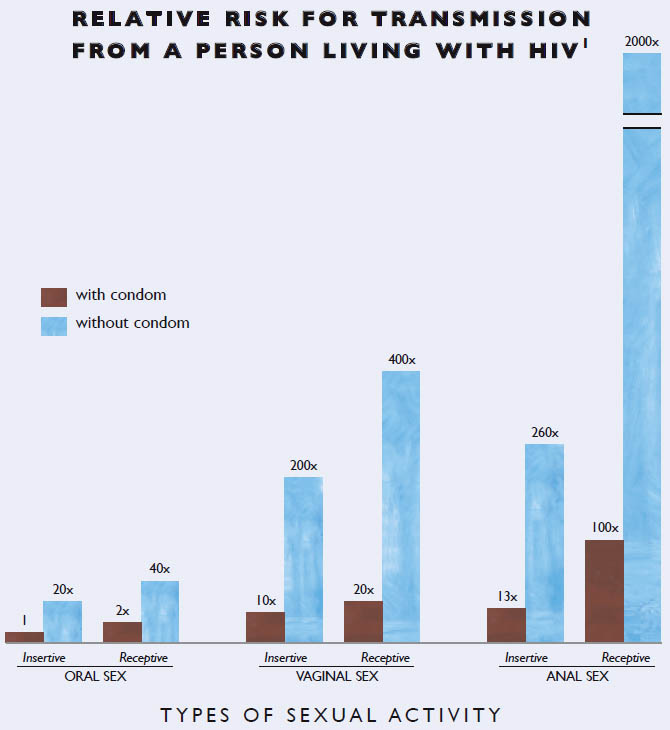
People often ask me how risky is oral sex? For the longest time, we knew that oral sex was safer than anal sex but we couldn’t put a number to it. Well, the CDC has come out with a graph that pretty much sums it up.

As you can see, being the “top” in generally safer than being a “bottom.” That is, if you’re getting cum in your body, you’re at a much greater risk. Just speaking of anal sex, for example, the top is 13 times more likely to get HIV (when not using a condom), as apposed to the bottom being 2,000 times more at risk.

Keep in mind too, the number of sex partners you have makes a difference, which isn’t represented here. It only takes one HIV positive person to pass on the infection, but the larger the number of sex partners, the greater your chances of having sex with someone who is, in fact, HIV positive.

People living with HIV disproportionately affected by hepatitis

From blog.AIDS.gov:

People living with HIV who are also living with viral hepatitis are at increased risk for serious, life threatening complications.  As a result, all persons living with HIV should be tested for Hepatitis B and Hepatitis C by their doctors. Co-infection with hepatitis may also complicate the management of HIV infection.

In order to prevent co-infection with Hepatitis B, the Advisory Committee on Immunization Practices recommends universal Hepatitis B vaccination of susceptible patients with HIV/AIDS.  Hepatitis A and Hepatitis B vaccines are also recommended for all men who have sex with men, users of illicit drugs, and others at increased risk of infection. There is no vaccine for Hepatitis C.

You can also read the full article on the Pitt Men’s Study Website.

HIV study: 96% reduction in HIV transmission

Press release from HIV Prevention Trials Network:

Thursday, 12 May 2011, 11 am EST
Washington, DC

Initiation of Antiretroviral Treatment Protects Uninfected Sexual Partners from HIV Infection (HPTN Study 052)

Men and women infected with HIV reduced the risk of transmitting the virus to their sexual partners through initiation of oral antiretroviral therapy (ART), according to findings from a large multinational clinical study conducted by the HIV Prevention Trials Network (HPTN), a global partnership dedicated to reducing the transmission of HIV through cutting-edge biomedical, behavioral, and structural interventions.

The study, known as HPTN 052, was designed to evaluate whether immediate versus delayed use of ART by HIV-infected individuals would reduce transmission of HIV to their HIV-uninfected partners and potentially benefit the HIV-infected individual as well. Findings from the study were reviewed by an independent Data and Safety Monitoring Board (DSMB).The DSMB recommended that the results be released as soon as possible and that the findings be shared with study participants and investigators. The DSMB concluded that initiation of ART by HIV-infected individuals substantially protected their HIV-uninfected sexual partners from acquiring HIV infection, with a 96 percent reduction in risk of HIV transmission. HPTN 052 is the first randomized clinical trial to show that treating an HIV-infected individual with ART can reduce the risk of sexual transmission of HIV to an uninfected partner.

“This is excellent news,” said Dr. Myron Cohen, HPTN 052 Principal Investigator and Associate Vice Chancellor for Global Health and Director of the Institute of Global Health and Infectious Diseases at the University of North Carolina at Chapel Hill. “The study was designed to evaluate the benefit to the sexual partner as well as the benefit to the HIV-infected person. This is the first randomized clinical trial to definitively indicate that an HIV-infected individual can reduce sexual transmission of HIV to an uninfected partner by beginning antiretroviral therapy sooner. HPTN recognizes the significant contribution that this study’s participants have made to furthering the progress in HIV treatment and prevention. We are very grateful for their participation.”

Media inquiries:

Matt Matassa
703.647.1909
mmatassa@fhi.org

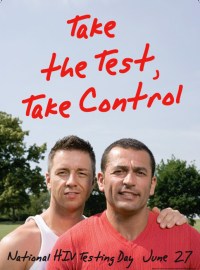
“Take the Test, Take Control” – National HIV testing day

National HIV Testing Day (NHTD) is an annual campaign coordinated by the National Association of People with AIDS to encourage people of all ages to “Take the Test, Take Control.”

Early HIV diagnosis is critical, so people who are infected can fully benefit from available life-saving treatments. Currently, almost 40 percent of people with HIV are not diagnosed until they already have developed AIDS. That can be up to 10 years after they first became infected with HIV. Finding out whether you are infected with HIV is the first step to improving your health and the health of your partners and your family.

Find out more about National HIV Testing Day and where to get tested.

Find out how you can help promote Testing Day.

President Obama speaks out for National HIV Testing Day.

Institute of Medicine releases long-awaited report on LGBT health

From the Gay and Lesbian Medical Association

Washington, DC – The Institute of Medicine today released its long-awaited report, The Health of Lesbian, Gay, Bisexual, and Transgender People: Building a Foundation for Better Understanding. The National Institutes of Health commissioned this groundbreaking report, and a distinguished panel of experts dedicated more than a year to evaluating the state of LGBT health research and crafting recommendations for improving the health of the LGBT community.

Read the full report at The National Academies Press Website.

HPV in half of U.S. men

From the Huffington Post:

“A study out yesterday in The Lancet by Moffitt Cancer Center researcher Anna Giuliano, Ph.D., and her colleagues finds that 50 percent of men ages 18 to 70 in Brazil, Mexico, and the U.S. have genital infection with human papillomavirus, or HPV. HPV is the virus that causes cervical cancer in women. It also causes warts and cancer of the genitals and anus in both men and women.”

The article goes on to state:

“An infection rate of 50 percent for a virus that can cause cancer sounds scary. But knowing a few more facts about HPV helps put the risk in perspective. About 90 percent of men and women infected with HPV virus get rid of it on their own within about two years. There are many different strains of HPV — some that cause cancer and some that don’t. Only about 6 percent of men have genital infection with HPV 16 — the strain linked to more than 90 percent of cancers of the head and neck. And only about 0.6 percent of men have HPV 16 in specimens taken from their mouths; what percentage of those men go on to develop head and neck cancer is unknown.”

To get tested for HPV that might cause anal cancer, you can talk to your doctor or call the Anal Dysplasia Clinic
at UPMC, Falk Medical Building, 7th Floor. Their number is 412-647-7228.

SPBP new mailing address and fax

If you’re on a Special Pharmaceutical Benefits Program (SPBP) for your HIV medication, eligibility processing has been shifted to the vendor responsible for processing annual recertification. You will need to mail all applications to the following mailing address:

Commonwealth of Pennsylvania 
Department of Public Welfare
Special Pharmaceutical Benefits Program
PO Box 8808
Harrisburg, PA  17105-9920

Applications and supporting documents can also be sent via fax to: (717) 651-3608        

NOTE:   SPBP still requires a minimum of 3 business days to process all applications. Please allow 3 business days before calling for a status update on applications submitted.  Approved applicants will receive a phone call to verify acceptance and provide the SP# at the time of approval.  An approval letter containing an SPBP Identification card and introductory information will also be mailed the same day the application is approved.  

SPBP staff will continue to address questions and concerns via the SPBP Customer Service Line Monday through Friday 8:00 a.m. to 4:30 p.m. Please call toll free 1800-922-9384 for questions/concerns regarding program eligibility, benefits or application & recertification processes. 

For more information about SPBP, go to the PA Dept. of Public Welfare Website.

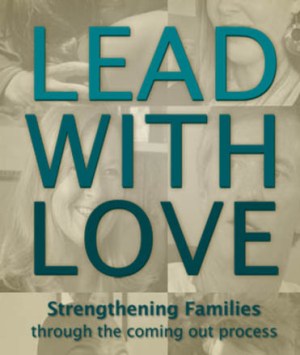
Lead With Love

LEAD WITH LOVE follows four families’ experiences in learning that they have a gay or lesbian child. Created for parents who are working through this news themselves, this poignant and informative film shares real stories from parents and children, factual information from psychologists, educators, and clergy, and concrete guidance to help parents keep their children healthy and safe during this sometimes challenging time.

Can it be true??

From the Huffington Post:

On the heels of World AIDS Day comes a stunning medical breakthrough: Doctors believe an HIV-positive man who underwent a stem cell transplant has been cured [of HIV] as a result of the procedure.

Timothy Ray Brown, also known as the “Berlin Patient,” received the transplant in 2007 as part of a lengthy treatment course for leukemia. His doctors recently published a report in the journal Blood affirming that the results of extensive testing “strongly suggest that cure of HIV infection has been achieved.”

Read the full article on the Huffington Post.

The Pitt Men’s Study and PA Prevention Project Sponsor New Webcast “Positive OUTlook”

This past summer, The Pitt Men’s Study and The PA Prevention Project began sponsoring a live Webcast called Positive OUTlook. The purpose of the show is to get health related information to the LGBT community in the greater Pittsburgh area. Positive OUTlook airs every Thursday from 1 to 2 p.m. on www.outonline.com. If you catch the show live you can connect online and submit questions to the show’s guests. You can also call in. After the show airs on the Internet, it is archived on outline.com for future viewing.

Some of the topics that have been covered so far include: the overall health issues of the LGBTQ community, mental health issues, and sexuality. If you would like to be a guest on the show or just want more information, contact the show’s host, Nayck Feliz at  412-383-2612. You can also send an email to nbf5@pitt.edu.

Homophobia a factor for high rate of HIV infection in black men?

NEW YORK (Reuters Health) – Among gay men in the United States, blacks are more likely than whites to believe that homosexuality is “wrong” – and these feelings might be contributing to the black men’s higher risk of HIV infection, researchers suggest.

According to the U.S. Centers for Disease Control and Prevention, in 2006 African-Americans accounted for nearly half (45%) of new infections in the 50 states and the District of Columbia. Also, according to recent estimates, they account for a disproportionate 24 percent of reported HIV cases among gay and bisexual men in the U.S. The reasons are not clear. Studies have not found a higher rate of risky sexual behavior among black men versus white men — but a range of factors are likely at work.

Read the full story on msn.com.

LA-based web soap opera explores sexual decision making among young gay men

“Traditional methods of HIV prevention, like condom distribution, remain incredibly important,” says independent filmmaker Dave OʼBrien, 33, who wrote, directed and co-developed IN THE MOMENT, “Whatʼs missing among a younger generation of gay guys is any real discussion about HIV and safer sex. IN THE MOMENT is a sexy and entertaining way to capture their attention and stimulate dialogue regarding real-world sexual situations many gay men face today.”

IN THE MOMENT starts with an authentic, sexy and sometimes humorous web soap opera that explores the full range of factors that come into play in sexual decision making among young gay men. Issues like self-esteem, dating, relationships, age, body image, addiction and others are addressed as key factors in the lives of the characters. The episodes are broken into 3-5 minute “webisodes” that are easily accessible on most computers. The webisodes are a starting-place for discussion. Users create their own IN THE MOMENT profile on the site and use it to communicate on message boards and with other members.