From HIV.gov…
A series of real stories from real people about their unique experiences along the HIV Continuum of Care.
See more at Positivespin.HIV.gov.

From HIV.gov…
A series of real stories from real people about their unique experiences along the HIV Continuum of Care.
See more at Positivespin.HIV.gov.
From USA Today…
Gay and bisexual men in the United States are twice as likely as heterosexual men to get skin cancer, a new study shows.
One likely reason: Gay and bisexual men are three times more likely to engage in indoor tanning, according to the study to be presented Friday in San Francisco at a meeting of the American Academy of Dermatology.
The study suggests that anti-tanning messages, most often aimed at young women, need to be broader, says researcher Sarah Arron, an associate professor of dermatology at the University of California, San Francisco. “The primary reason that men and women engage in indoor tanning is because of the cultural association of tanning with a healthy look and overall attractiveness,” Arron says. “We need to dispel the myth of the healthy tan.”
Tanning, whether in the sun or in a tanning bed, can cause skin cancer, including melanoma, the most dangerous kind, according to the U.S. Surgeon General’s office.
Healthcare providers and consumers need HIV-related drug information and, increasingly, they depend on mobile devices to access that information. AIDSinfo is meeting both needs with the release of the AIDSinfo Drug App. Using data from theAIDSinfo Drug Database, the drug app provides information on more than 100 HIV-related Food and Drug Administration (FDA)-approved and investigational drugs. The AIDSinfo Drug App—provided free from the National Library of Medicine at the National Institutes of Health—is available for iOS and Android devices.
The information on the AIDSinfo Drug App, offered in English and Spanish, is tailored to meet the needs of both healthcare providers and consumers. The app works offline, ensuring that healthcare providers and consumers can access vital drug information anywhere—even in healthcare facilities that may not have an Internet connection.
The AIDSinfo Drug App pulls FDA labels from Daily Med for approved HIV-related drugs. The app also integrates information on drug nomenclature and chemical structure from ChemIDplus. Information from the labels is condensed in easy-to-understand summaries in English and Spanish for consumers.
Users can also access information on HIV-related drugs under investigation via the AIDSinfo Drug App. The investigational drug summaries, which are developed from the latest clinical trial results, are tailored by audience: technical, more detailed summaries for healthcare providers and less complex summaries in English and Spanish for consumers.
Users can also personalize the AIDSinfo Drug App. According to their needs, users can set pill reminders, bookmark drugs, or add personal notes:
Stay tuned as AIDSinfo updates the app with additional features. Visit AIDSinfo to download the drug app to your iOS or Android device. And keep us posted on your experience with the app. We welcome your questions and comments at ContactUs@aidsinfo.nih.gov.
From AIDS.gov…
Like so many Americans, I have seen the tragedy first hand, of friends lost to HIV/ AIDS. I’ve also seen the hope of those living with HIV as we continue to work toward an AIDS free generation.
Each February 7th, we mark National Black HIV/AIDS Awareness Day (NBHAAD). It’s an opportunity for all of us to honor the memory of those we’ve lost, and to call attention to the fact that HIV continues to disproportionately affect African American men, women, and youth.
The numbers are startling: African Americans represent only 14 percent of the U.S. population, but account for almost half of all new HIV infections in the United States per year, as well as more than one-third of all people living with HIV in our nation.

This year’s NBHAAD theme, “I Am My Brother’s/Sister’s Keeper: Fight HIV/AIDS” challenges all of us to work to eliminate these unacceptable health disparities by ramping up our HIV prevention efforts, encouraging individuals to get tested, and helping those who are living with HIV to access the life-saving medical treatment they need.
One of the ways the Department of Health and Human Services is responding to this charge is by launching a new four-year demonstration project funded through the Secretary’s Minority AIDS Initiative to address HIV disparities among men who have sex with men (MSM), including men of color.
We are focusing on HIV disparities among MSM, including MSM of color, because black gay and bisexual men—particularly young men—remain the population most heavily affected by HIV in the U.S. Young black MSM account for more new infections (4,800 in 2010) than any other subgroup of MSM by race/ethnicity and age. These shocking figures demand that we take action.
The cross-agency demonstration project will support community-based models in strengthening HIV prevention efforts, addressing gaps in care for those living with HIV, and helping meet the health care needs of MSM, including MSM of color. More specifically, the funding will support state and local health departments in providing MSM of color, and other MSM, with the health and social services they need to live healthy lives free of HIV infection. For those already infected, the funding will support community-based services that help MSM of color, and other MSM, get diagnosed and linked to the right care—including substance abuse and mental health treatment as well as necessary social services, like stable housing. Helping people access and remain in HIV care is good medicine and important to our public health—since it lowers individuals’ risk of passing HIV to others.
We all have a role to play in working toward an AIDS free generation. Education and understanding prevention and treatment of HIV is important. And HIV testing is also critical as we continue to tackle this disease. One thing we can all do is speak out – speak out against HIV stigma whenever and wherever you encounter it. Stigma and shame continue to prevent too many people from seeking testing and getting the health care they need to live healthy, active lives.
Read more about HIV among African Americans and efforts to prevent and treat this disease at CDC.gov.
From the New York Times…
Drugs to treat H.I.V. and AIDS are being priced out of reach for many patients enrolled in insurance plans through the new health care exchanges, despite warnings that such practices are illegal under the Obama administration’s health care law, according to a new analysis by Harvard researchers.
The study, to be published on Wednesday in an article in The New England Journal of Medicine, looked at 48 health plans in 12 states and found that a quarter of the plans showed evidence of what researchers called “adverse tiering,” or placing all of the drugs used to treat H.I.V. in a specialty tier where consumers are required to pay at least 30 percent of the cost of the drug.
The financial impact can be drastic, the researchers found: A patient taking a common H.I.V. treatment, Atripla, would pay about $3,000 more a year in a restrictive plan compared with someone enrolled in a more generous plan, even after accounting for the fact that the more restrictive plans tended to charge lower monthly premiums.
“That’s really a large cost difference, and really is a very significant financial constraint for those with chronic conditions, particularly H.I.V.,” said Douglas B. Jacobs, the lead author of the study, who is pursuing degrees in public health at the Harvard T. H. Chan School of Public Health and medicine at the University of California, San Francisco.
Continue reading on The New York Times.
From Queerty.com…
Think twice before hooking up with that out-of-towner this holiday weekend. And, if you do, be safe.
The CDC has just released reports that number of syphilis infections in the United States jumped a whopping 10 percent from 2012 to 2013, with gay and bisexual men accounting for 75 percent of the increase.
According to the report, 17,357 cases of syphilis were reported last year. That’s 5.5 cases per every 100,000 people.
Dr. Jill Rabin, co-chief of the division of ambulatory care in the Women’s Health Programs-PCAP Services at North Shore-LIJ Health System in New Hyde Park, N.Y., called the rise in syphilis cases “very alarming.”
“Syphilis is like the canary in the coal mine for HIV,” she said. “People are going to be positive for syphilis before they are diagnosed with HIV. This means that there is a potential increase in HIV cases.”
According to MedicalXpress, the sores caused by syphilis make HIV transmission easier. In rare cases, syphilis can lead to serious health problems, including death. Though it’s easy to cure with antibiotics if caught early.
“Having an STD doesn’t mean someone is dirty or broken,” said Fred Wyand, spokesperson for the American Sexual Health Association. “Far from it.”
Wyand urged people not to let the stigma of a STD prevent them from being tested and treated.
“One of the great barriers to having sexual health conversations is the sense of embarrassment. People need to have frank, open conversations,” he said. “It’s not about sex. It’s about health.”
From HealthDay.com…
By Steven Reinberg
The number of cases of syphilis in the United States jumped 10 percent from 2012 to 2013, with gay and bisexual men accounting for 75 percent of the increase, U.S health officials reported Tuesday.
Rates of another sexually transmitted disease — chlamydia — fell for the first time in 30 years, with more than 1.4 million reported cases in 2013. This represented a 1.5 percent decrease from 2012, according to the U.S. Centers for Disease Control and Prevention.
“There are over 20 million cases of sexually transmitted diseases [STDs] every year in the United States, and they continue to pose a risk of lifelong complications for millions of Americans,” said Dr. Jonathan Mermin, director of CDC’s National Center for HIV/AIDS, Viral Hepatitis, STD, and TB Prevention.
According to the report, 17,357 cases of syphilis were reported in 2013 — a rate of 5.5 per 100,000 people.
There are a variety of reasons that put gay and bisexual men at high risk for syphilis, said Mermin.
“Some are the high number of sexual partners and sexual networks that create a vicious cycle where the prevalence of syphilis is higher. And that leads to higher incidence, which leads to higher prevalence, and that cycle can increase the frequency of infection,” he said.
Continue reading on HealthDay.
From the Windy City Media Group…
by Lawrence Ferber
Hearing the words “I’m HIV-positive” made Bryan* ( names and some details have been changed ) freeze. A 23-year-old graphic designer, Bryan had met a guy at a Boystown gay club, a svelte 25-year-old tourist, Zach, with whom he danced, drank and laughed. Around 1 a.m., just before heading to Zach’s hotel for more private activities together, Zach disclosed his positive HIV status. His viral load was undetectable—successfully suppressed with a drug regimen to the point it was low to no risk for transmission; also, he was clear of other STDs and he packed an ample supply of condoms.
Bryan declined to go back with him, though, offering a politely worded excuse rather than saying what he really thought: “I don’t sleep with HIV-positive guys.” Zach, however, had heard those words, or variations of the same, more than a few times since his diagnosis a couple of years ago, and he could see them clearly in Bryan’s green eyes. He felt like shit—judged and tainted—and while Zach wouldn’t lie and tell someone he was negative, he understood why so many others in his shoes have and do. Bryan ended up getting lucky a couple of hours later at another bar with Alex, an architect-in-training who said he was negative.
There’s a twist: Bryan, in fact, was positive, although he wouldn’t find out that until six months later, when he got tested for the first time in almost three years—something he put off because, in the back of his mind, he was concerned about a bareback encounter with someone he met on Grindr who, the next day, deleted his profile and disappeared, as if in a magic poof of smoke.
“Stigma is really damaging on both ends,” said Matthew Rodriguez of the comprehensive HIV/AIDS resource site The Body. “For negative people, stigma can sometimes stop them from getting tested. If they feel they did anything that put them at risk, they may not want to get tested because the result may be devastating. I think it also stops people from interacting with those living with HIV as full people. People just look at you as a status, as a virus.”
Continue reading on Windy City Media Group.
The Allegheny County Health Department has documented an alarming, ongoing increase in Syphilis infections among men who have sex with men in the greater Pittsburgh area. Syphilis is a sexually transmitted disease that, if untreated, can cause serious health problems. You can get Syphilis and not have any initial symptoms so the only way to know you’re infected is to get a simple blood test. Syphilis is 100% curable.
The Health Department suggests all sexually active gay and bi men get tested for Syphilis. To find free testing near you, go to https://gettested.cdc.gov/.
You can also call the Allegheny Health Department to find out more about getting a free test: (412) 578-8332.
___
To find out more about Syphilis go to the CDC Website at http://www.cdc.gov/std/syphilis/
To read the official Allegheny Health Department press release, Syphilis health alert November 17 2014.
From aidsmap.com…
The number of people using Truvada for pre-exposure prophylaxis (PrEP) in the US is increasing and a growing proportion of users are men, according to an analysis of data from approximately half of American pharmacies presented this week at the HIV Drug Therapy Glasgow conference.
PrEP refers to the use of antiretroviral medications to prevent HIV infection. Gilead Sciences’ Truvada(tenofovir + emtricitabine) taken once daily was shown to be effective in the iPrEx study of mostly gay and bisexual men, reducing the risk of HIV infection by 42% overall, rising to 92% among participants with blood drug levels indicating regular use. A mathematical model suggested that taking Truvadafour times per week would provide 99% protection, and in an open-label extension of iPrEx none of the men who took Truvada at least this often became infected.
The US Food and Drug Administration (FDA) approved once-daily Truvada for PrEP in July 2012. In May of this year, the US Centers for Disease Control and Prevention (CDC) recommended that people at ‘substantial risk’ should consider PrEP to prevent HIV infection, and the World Health Organization (WHO) has also recommended PrEP as an option for at-risk gay men.
Yet uptake of Truvada PrEP has not been as widespread as many had hoped, facing barriers such as lack of awareness among people at risk for HIV, resistance from some medical providers and inconsistent insurance coverage.
Continue reading on aidsmap.com.
From the Advocate online…
Despite recommendation by the Centers for Disease Control and Prevention, and studies that indicate that PrEP can reduce HIV transmission by 96 and up to 99 percent, there are still relatively few gay and bisexual men on the drug.
It can be hard to find anyone among your friends to ask about it. And what makes a person decide they want to go on the once-daily pill varies a lot. The Advocate reached out to gay and bi men, as well as serodiscordant couples, who use the drug to hear their reasons. They offered advice for those on the fence about it. Read their stories in their own words.
From aidsmap.com…
People living with HIV in the United States who receive their care through the Ryan White HIV/AIDS Program have good rates of retention and virological suppression, investigators report in the online edition of Clinical Infectious Diseases. Of the patients seen at least once in 2011, some 82% were retained in care and 73% achieved virological suppression.
These outcomes dwarf those seen for most people living with HIV in the US – previous reports have estimated that as few as 40% were retained in care and 19% had achieved virological suppression.
A second new report focuses on gay, bisexual and other men who have sex with men, demonstrating that outcomes continue to be unacceptably poor in this group. Of those who have ever been diagnosed with HIV, 51% were retained in care and 42% achieved virological suppression.
However, both new studies found that outcomes were poorer in younger people, African American people and some other ethnic groups.
Continue reading on aidsmap.com
From Gay Men’s Health Crisis…
On Thursday, September 25, 2014, the Kaiser Family Foundation released a new alarming report reflecting gay and bisexual men’s attitudes, knowledge, and experiences with HIV/AIDS and new HIV therapies in the United States. Their survey on HIV/AIDS in the lives of gay and bisexual men in the United States reports that 56% of gay and bisexual men are not personally concerned about HIV or AIDS affecting them and 30% have never been tested for HIV.
“HIV/AIDS might not be a death sentence anymore, but there are still 50,000 new infections in the United States every year-and gay and bisexual men are still among those most at risk,” said GMHC CEO Kelsey Louie. ” The Kaiser Family Foundation study is a needed wake-up call that communicating the correct information about HIV and AIDS to the public has never been more critical. We must do more to educate our gay and bisexual men about how HIV and AIDS can affect them, and how life-saving medications like PrEP and PEP can help them prevent HIV infections and stay healthy.”
Additional Background:
Eight out ten gay and bisexual men surveyed also said that they have heard a little or nothing about PrEP, a life-saving medication that can prevent HIV-infections. Additional findings from the survey can be found here. The Foundation’s survey comes on the heels of a new CDC report showing that 58% of gay and bisexual men diagnosed with HIV are not virally suppressed.
Find free HIV testing locations near you by entering your zip code at http://hivtest.cdc.gov
From the New York Times…
Gay men and their doctors aren’t talking enough about sex, and that’s making it harder to control the spread of H.I.V.
That’s the conclusion of a new survey of gay and bisexual men by the Kaiser Family Foundation released on Thursday. It found that 47 percent of the men have never discussed their sexual orientation with their doctors, and 56 percent have never been advised by a doctor to be tested for H.I.V.
For decades we’ve been hearing that H.I.V. is not a gay disease, and that’s true globally, but it’s a misrepresentation of the epidemic in the United States. That misunderstanding can lead to a complacency that furthers its spread, public health officials warn. A majority of new infections occur among men who have sex with men. Kaiser estimates that 12 to 13 percent of gay and bisexual men in the United States are living with H.I.V., more than 20 times the rate among the general population.
“It’s in the highest bracket of prevalence that you see in some of the hardest-hit countries in sub-Saharan Africa,” says Jen Kates, Kaiser’s director of global health and H.I.V. policy. “It’s not that America shouldn’t care about H.I.V., but that gay and bisexual men should care more.”
Continue reading on the New York Times online.
The Pennsylvania Department of Health in conjunction with the Allegheny County Health Department (ACHD) has documented an alarming increase in Syphilis cases, primarily among men who have sex with men (MSM) in Allegheny County. As of September 10, 2014, the ACHD has reported 67 cases of early Syphilis which now exceeds the total of 63 cases reported in all of 2013. Here is a breakdown of the data:
· 54% of the cases have been reported individuals under the age of 30
· 96% of the cases reported were male
· 75% of the male cases reported with MSM risk factors (had sex with other men)
· 39% of the male cases were co-infected with HIV
You can get Syphilis and not have any symptoms so the only way to know you’re infected is to get tested with a simple blood test. And if you do have symptoms, note that Syphilis has any number of symptoms that can look like symptoms from other diseases. One example is a painless sore that you would get after you are first infected can be confused for an ingrown hair, zipper cut, or other seemingly harmless bump. Another example is a rash over the body that can sometimes (but not always) involve the palms of the hands and the soles of the feet. As a result of the uptick in Syphilis cases, we are recommending that all sexually active MSM get a Syphilis test. The PA Department of Health as well as the Centers for Disease Control recommend that all sexually active MSM receive full STD screening (including HIV) annually. The Pitt Men’s Study offers testing for syphilis (as well as testing for Gonorrhea and Chlamydia) as part of your routine study visit. Free testing is also available at the Allegheny County Department of Health.
To find testing near you, check out the CDC testing database at http://hivtest.cdc.gov/
To find out more about Syphilis specifically, go to http://www.cdc.gov/std/syphilis/stdfact-syphilis.htm
To subscribe to Pitt Men’s Study Health Alerts, send an email to rgy2@pitt.edu with the word “subscribe” in the subject line.
To find out more about Health Alerts, go to http://pittmensstudy.com/health-alerts/
From the Latin Post…
The Center for Disease Control rolled out a new campaign to target Hispanic and Latino communities in addressing HIV/AIDS, citing a high number of new infections each year. Annually, the CDC reports, 500,000 people become infected each year in the U.S., and the Hispanic and Latino population — which is 16 percent of the nation’s population — constitutes 21 percent of new infections.
Introducing their new campaign, accompanied with two videos highlighting the information, the CDC said, “We all have a role to play. We can stop HIV one conversation at a time. Together, all of our conversations can help protect the health of our community and reduce the spread of HIV. ” The “one conversation at a time” tagline is the being promoted ahead of the National Latinos AIDS Awareness Day, which coincides with the last day of Hispanic Heritage Month, on Oct. 15.
The CDC said that 1 in 36 Hispanic/Latino men and 1 in 106 Hispanic/Latina women will be diagnosed with HIV at some point in their lives. “Because there is no single Latino culture, the factors driving the epidemic in this population are as diverse as the communities themselves,” the CDC said.
Despite prevention methods and measures, the Latinos continue to bear a heavier burden than most when it comes to HIV/AIDS. Where Latinos live also affects the numbers of infected men specifically. HIV diagnosis in the Northeast is more than twice that of any other region in the country, mostly from male-to-male sexual contact and intravenous drug use. In the South, those with HIV are more likely to have been affected by male-to-male sexual contact, according to the CDC.
One of the campaign videos by the CDC titled Sin Verguenza, or “Without Shame,” starts off like a soap opera — introducing the main characters, each with a somber face as their names flash across the screen. It is intended to engage the audience as the 8-minute video begins with an introduction to the fictional Salazar family. Once over, one of the characters comes into the camera frame and asks the audience if they can identify which of the family members may have HIV/AIDS.
This is the first installment in the campaign, which promises more episodes. “It may not always be easy to talk about HIV/AIDS, but we must talk openly about it to protect our community. By learning the facts about HIV and talking about ways to protect ourselves, our loved ones, and our community, we can help increase HIV awareness, decrease stigma and shame that are too often associated with HIV, and play a part in stopping HIV in the Hispanic/Latino community,” the CDC said.
From GPB News…
In order to slow the spread of HIV, certain people who do not have the virus but are at risk should take medicine to prevent becoming infected. That’s the recommendation of the Centers for Disease Control and Prevention and, just recently, the World Health Organization. The preventive treatment is known as PrEP, for pre-exposure prophylaxis.
Eric McCulley made the decision to start PrEP. He’s 40, gay and HIV-negative. Outside an Atlanta coffee shop, he pulls out a plastic baggy with a few blue pills. “They’re a decent size, actually,” he says. “Some people might call them a horse pill.” The pill is called Truvada, a combination of two drugs used to treat HIV. Despite McCulley’s negative HIV status, he’s taken the pill daily for the past few months.
After hearing about the treatment and doing extensive research on his own, McCulley made an appointment with his primary care doctor earlier this year. “He was very supportive about it. He encouraged me to do it,” he says. “He gave me a lot of stuff to read, gave me a lot of stuff to think about, and told me I was a good candidate for it. So off we went.”
So far, McCulley says, the only change the drug has made in his life is in his attitude. “I have what I was looking for. I have peace of mind. I feel like I’ve taken responsibility for my health,” he says.
But some PrEP users worry that not everybody in the medical community is up to speed. Although Truvada has been on the market for a decade, only recently have prescribing guidelines been available. Dylan West is a 25-year-old Atlanta resident and works in international aid. He is also gay and recently found out firsthand that not every doctor is as familiar with PrEP as McCulley’s is.
From the Bay Area Reporter online…
Gay and bisexual men who are at risk for HIV infection should consider using antiretroviral drugs for pre-exposure prophylaxis, better known as PrEP, according to new guidelines from the World Health Organization.
The WHO recommendation is similar to U.S. Centers for Disease Control and Prevention guidelines released in May, which state that health care providers should consider advising people at “substantial risk” to use PrEP to prevent HIV infection.
“With the WHO’s recommendation, two of the world’s most important public health institutions have recommended that gay and bisexual men who could become infected by HIV carefully consider PrEP,” said Project Inform Executive Director Dana Van Gorder. “In Project Inform’s view, this would especially include men and transgender women who ever bottom without condoms.”
Noting that HIV infection rates among gay and bi men remain high almost everywhere and new prevention options are urgently needed, WHO strongly recommended that men who have sex with men consider taking antiretroviral drugs as an additional method of protection along with condoms.
Continue reading here.
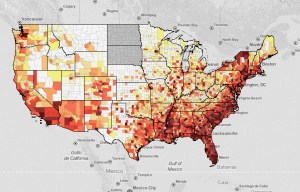
Click on the image to view the interactive map
AIDSVu is an interactive online map illustrating the prevalence of HIV in the United States. The national, state and local map views on AIDSVu allow users to visually explore the HIV epidemic alongside critical resources such as HIV testing center locations, HIV treatment center locations, and NIH-Funded HIV Prevention & Vaccine Trials Sites. The map also lets users filter HIV prevalence data by race/ethnicity, sex and age, and see how HIV prevalence is related to various social determinants of health, such as educational attainment and poverty.
The state- and county-level data on AIDSVu come from the U.S. Centers for Disease Control and Prevention’s (CDC) national HIV surveillance database, which is comprised of HIV surveillance reports from state and local health departments. ZIP code and census tract data come directly from state, county and city health departments, depending on which entity is responsible for HIV surveillance in a particular geographic area. AIDSVu is updated on an ongoing basis with HIV surveillance data released by CDC, as well as with new data and information from other sources as they become available.
 m4mHealthInfo.org