Some healthcare providers still deny treatment to HIV+ patients

From Thinkprogress.com:

Medical progress now ensures that HIV/AIDS is no longer a death sentence, but only for those who can access good medical care. The Centers for Disease Control and Prevention reports that almost three out of four Americans with HIV are not receiving enough medicine or regular health care “to stay healthy or prevent themselves from transmitting the virus to others.” Out of the 1.2 million people in the U.S. have HIV, 850,000 aren’t receiving regular treatment to keep the virus at a low enough level to prevent transmission or hurt their own health and 240,000 Americansdon’t even know they’re infected with HIV.

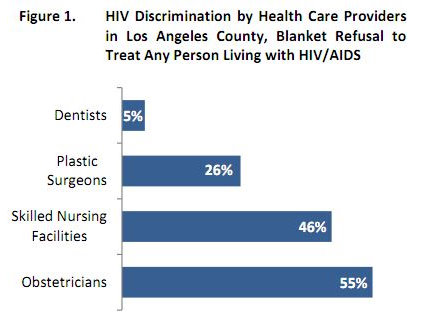
For some, medical treatment is  hard to come by. A Williams Institute study found that 5 percent of dentists in Los Angeles refused services to those with HIV/AIDs, a rate that is “lower than that of other health care providers. Over the past decade, “55% of obstetricians, 46% of skilled nursing facilities, and 25% of plastic surgeons” in L.A. “had policies that specifically discriminated against people living with HIV or AIDS.” Successful treatment rates “were lowest in blacks and women,” according to CDC director Dr. Thomas Frieden.

Read the full article on Thinkprogress.com.

Joint Commission releases LGBT field guide

A new field guide from the Joint Commission urges US hospitals to create a more welcoming, safe, and inclusive environment that contributes to improved health care quality for lesbian, gay, bisexual, and transgender (LGBT) patients and their families.

The field guide features a compilation of strategies, practice examples, resources, and testimonials designed to help hospitals in their efforts to improve communication and provide more patient-centered care to their LGBT patients.  The guide, Advancing Effective Communication, Cultural Competence, and Patient- and Family Centered Care for the Lesbian, Gay, Bisexual, and Transgender (LGBT) Community, was developed with support from the California Endowment and is available for free download below.

An independent, not-for-profit organization, The Joint Commission accredits and certifies more than 19,000 health care organizations and programs in the United States. Joint Commission accreditation and certification is recognized nationwide as a symbol of quality that reflects an organization’s commitment to meeting certain performance standards.

You can get the Field Guide on the Joint Commission website.

Be Well Pittsburgh! – helping uninsured Pittsburghers find health care

Be Well Pittsburgh! collaborates with health care consumers, health care providers, social service providers and community organizations to improve uninsured Pittsburghers’ awareness of and access to health care resources. Be Well! was founded in 2005 and was originally funded by a Seed Award from the Sprout Fund. The Seed Award supported the printing of 6,000 copies of a resource booklet entitled “Be Well! Healthcare Options for the Uninsured.”  The booklet was distributed in public venues
and through social service organizations in Pittsburgh. Its release was launched at a community health fair at the Quiet
Storm
coffeehouse during the summer of 2006. The information was listed online at http://www.bewellpgh.org shortly thereafter.

The information in the booklet and on the website was compiled using some existing resources and through additional research, as well as through information from health care providers themselves. All resources must be free or offered at reduced cost for
uninsured persons.

Be Well! continues to revise, update, print and distribute the booklets as funds allow.  They also continually revise and update the
website. They act as a reference source to individuals and service providers, participate in community events, and hold community information sessions on health care resources for uninsured people.

You can check out Be Well Pittsburgh! for services and more information.

New resources to protect people living with HIV/AIDS

From blogAIDS.gov

To mark the one-year anniversary of the release of the National HIV/AIDS Strategy, the Justice Department has launched a new section of its Americans with Disabilities Act (ADA) website, http://www.ada.gov/aids.

Persons with HIV and persons with AIDS are covered by the Americans with Disabilities Act (ADA), which gives federal civil rights protections to persons with disabilities in public accommodations, employment, and state and local government services. The new web page provides important information and resources related to combating discrimination on the basis of HIV/AIDS.

Users can visit the site to file an HIV/AIDS discrimination complaint, to obtain ADA technical assistance materials related to HIV/AIDS, and to get the latest updates about the Department’s efforts to stop HIV/AIDS discrimination. The website also provides easy access to an extensive collection of ADA settlement agreements, as well as information about enforcement, mediation, technical assistance, and certification activities.

Go to blogAIDS.gov for the full article.

Get a copy of the National AIDS Strategy here.

How safe is oral sex?

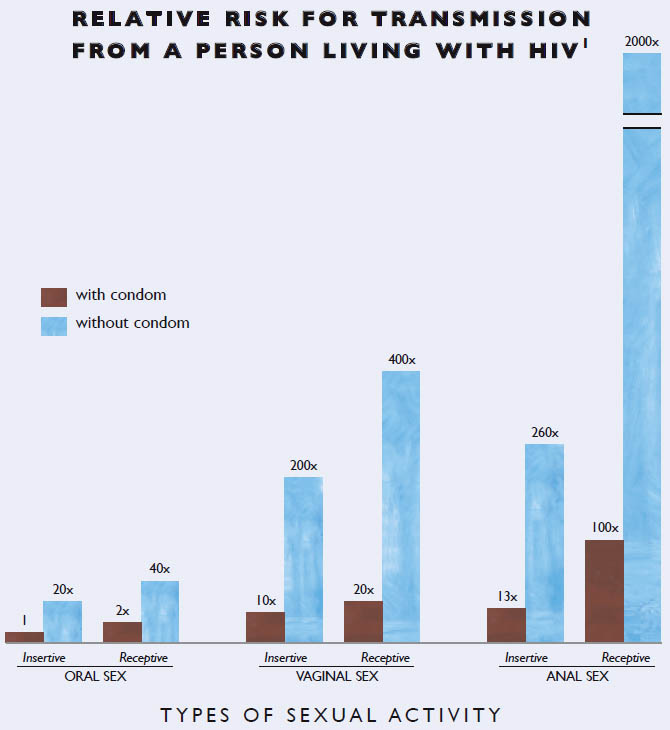
People often ask me how risky is oral sex? For the longest time, we knew that oral sex was safer than anal sex but we couldn’t put a number to it. Well, the CDC has come out with a graph that pretty much sums it up.

As you can see, being the “top” in generally safer than being a “bottom.” That is, if you’re getting cum in your body, you’re at a much greater risk. Just speaking of anal sex, for example, the top is 13 times more likely to get HIV (when not using a condom), as apposed to the bottom being 2,000 times more at risk.

Keep in mind too, the number of sex partners you have makes a difference, which isn’t represented here. It only takes one HIV positive person to pass on the infection, but the larger the number of sex partners, the greater your chances of having sex with someone who is, in fact, HIV positive.

“Take the Test, Take Control” – National HIV testing day

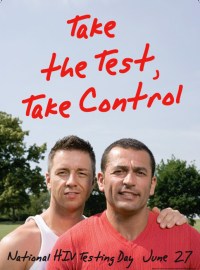
National HIV Testing Day (NHTD) is an annual campaign coordinated by the National Association of People with AIDS to encourage people of all ages to “Take the Test, Take Control.”

Early HIV diagnosis is critical, so people who are infected can fully benefit from available life-saving treatments. Currently, almost 40 percent of people with HIV are not diagnosed until they already have developed AIDS. That can be up to 10 years after they first became infected with HIV. Finding out whether you are infected with HIV is the first step to improving your health and the health of your partners and your family.

Find out more about National HIV Testing Day and where to get tested.

Find out how you can help promote Testing Day.

President Obama speaks out for National HIV Testing Day.

SPBP new mailing address and fax

If you’re on a Special Pharmaceutical Benefits Program (SPBP) for your HIV medication, eligibility processing has been shifted to the vendor responsible for processing annual recertification. You will need to mail all applications to the following mailing address:

Commonwealth of Pennsylvania 
Department of Public Welfare
Special Pharmaceutical Benefits Program
PO Box 8808
Harrisburg, PA  17105-9920

Applications and supporting documents can also be sent via fax to: (717) 651-3608        

NOTE:   SPBP still requires a minimum of 3 business days to process all applications. Please allow 3 business days before calling for a status update on applications submitted.  Approved applicants will receive a phone call to verify acceptance and provide the SP# at the time of approval.  An approval letter containing an SPBP Identification card and introductory information will also be mailed the same day the application is approved.  

SPBP staff will continue to address questions and concerns via the SPBP Customer Service Line Monday through Friday 8:00 a.m. to 4:30 p.m. Please call toll free 1800-922-9384 for questions/concerns regarding program eligibility, benefits or application & recertification processes. 

For more information about SPBP, go to the PA Dept. of Public Welfare Website.

Health Alert – N9

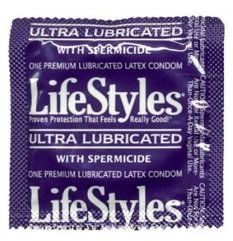
Nonoxynol-9 (or N-9) was created in the 1980’s as a spermicide—a method of contraception. The substance was also thought to prevent sexually transmitted diseases and it even killed HIV (the virus that causes AIDS) in test-tube studies. As a result, many gay and bisexual men who engaged in anal sex adopted the use of condoms and lubricants containing N-9 as a means to prevent HIV. Increased Risk for HIV Infection More recently, however, researchers have discovered N-9 can damage the lining cells of the rectum during anal sex, making a person more susceptible to contracting HIV.

What’s so troubling is that men who have sex with men are either unaware of this danger or don’t believe the danger actually exists. In fact, a study performed in San Francisco found that one quarter of respondents reported using lubricants containing N-9 despite repeated warnings from the Centers for Disease Control and Prevention, the World Health Organization and the Gay and Lesbian Medical Association to not use N-9 when engaging in anal intercourse. What Can You Do? Don’t use lubricants, condoms, or any other product that contains N-9. If the package says “spermicidal lubricant” on the box avoid it! The best way to prevent HIV infection when engaging in anal intercourse is to use latex condoms and water-based lubricants.  To learn more about N-9, you can go to this informative page on About.com.

A Word Form Your Local “Online Sexual Health Educator”

By: Ray Yeo

It’s been a little over a year since the Pitt Men’s Study started reaching out to guys in places like craigslist, gay.com and adam4adam. For the most part, I’d say we’ve been successful in getting our foot in the door and letting folks know we’re online to provide much-needed information about sexual health. But, as with many health intervention programs, there’s a core group of folks that still aren’t getting the message about avoiding sexually transmitted infections, including HIV.

We know that new HIV infections are still on the rise in Pennsylvania—even after all the grass roots sex education that happened early on, when the epidemic first laid waste to the gay community. There’s been a lot of talk about why the virus is still spreading and lots of folks agree we need to step up or efforts to continually educate the public about the risks of unsafe sex. But the one thing I don’t see a lot in the mainstream media is how finding sexual partners on the Internet plays a significant role in these new infections.

Mounting research indicates that guys who hook up online for sex (as apposed to traditional venues like bars and bath houses) have sex more often, have unprotected sex more often, and have more sex with guys who are HIV-positive. So it would seem pretty clear that we need to get our safer sex messages into the same chat rooms where these folks are hooking up.

One of our challenges is that, like the bars and bath houses in the early 1980’s, the owners of sex-related Websites don’t necessarily want to bring up issues of sexual health for fear that it will put off their clientele. The person in charge at Manhunt told me once that if their guys feel harassed by a sexual health educator, they’ll just take their business to gay.com. As a result, on Manhunt, I can’t advise guys about sexual health unless they chat with me first. The problem then, of course, is that if a person is online just for sex, he’s probably not going to make contact with me. The other problem is that guys often don’t know they’re at risk and, therefore, don’t know to ask for safer sex information. So how do we get the word out to guys who are living in an online bubble that’s devoid of safer sex messages?

One solution is to spread the word that men who are looking for sex with men on-line do need special sexual health information. We all know we’re supposed to use a condom for anal sex, but how many guys know that drinking and using drugs can lower your inhibition and turn a moment of safe sexual pleasure into (at best) prolonged medical treatments? How many guys know that, if you don’t like to use a traditional condom (for anal sex) because it doesn’t feel good, you can use a female condom instead? Would you know to call your doctor and ask for immediate “post-exposure prophylaxis” treatment if you know you’ve been exposed to HIV in the last 72 hours? 

Another potential solution is to expand our online presence. To this end, we’ve created the gay/bi friendly Website m4mHEALTHYsex.org—a place where guys can go to find out about HIV and other STDs. The site hosts user-friendly “sexual health avatars”—animated characters who can answer basic questions about sexually transmitted diseases. Users can also search by zip code to find information like gay-friendly medical providers and local testing centers. And, if for some reason a person can’t find the information he’s looking for, the user can email the staff at the Pitt Men’s Study and pose questions to our staff of medical professionals (folks who’ve been dealing with the health of gay and bi men for 25 years).       

We’ve come a long way in the treatment for HIV infection. And although modern anti-viral drugs are a genuine life-saving breakthrough, we still don’t have a cure or a vaccine to prevent it. Furthermore, as anyone on those miraculous antiviral drugs will tell you, having HIV is still a life-altering experience—and not in a good way.

In short, getting the gay and bi male community to understand that they still need information about safer sex is critical. If you’re picking up guys online for sex, you may be treading on thin ice. You may think you know it all, but, as the indisputable numbers of new HIV infections becomes more apparent, you might want to think twice when you see that “online sexual health educator” profile on Manhunt. Go ahead, ask me a question. I might be able to put you on the right track toward a better, safer sex life.