Be Well Pittsburgh! – helping uninsured Pittsburghers find health care

Be Well Pittsburgh! collaborates with health care consumers, health care providers, social service providers and community organizations to improve uninsured Pittsburghers’ awareness of and access to health care resources. Be Well! was founded in 2005 and was originally funded by a Seed Award from the Sprout Fund. The Seed Award supported the printing of 6,000 copies of a resource booklet entitled “Be Well! Healthcare Options for the Uninsured.”  The booklet was distributed in public venues
and through social service organizations in Pittsburgh. Its release was launched at a community health fair at the Quiet
Storm
coffeehouse during the summer of 2006. The information was listed online at http://www.bewellpgh.org shortly thereafter.

The information in the booklet and on the website was compiled using some existing resources and through additional research, as well as through information from health care providers themselves. All resources must be free or offered at reduced cost for
uninsured persons.

Be Well! continues to revise, update, print and distribute the booklets as funds allow.  They also continually revise and update the
website. They act as a reference source to individuals and service providers, participate in community events, and hold community information sessions on health care resources for uninsured people.

You can check out Be Well Pittsburgh! for services and more information.

“Stigma May Take Toll on Lesbians, Gays”

A post from MedlinePlus.com:

The stigma and inequalities that lesbian, gay and bisexual people face on a daily basis can increase their stress level and affect their well-being, according to a new study.

“Imagine living life anticipating exclusion from your friends, family and professional circles simply because of who you are and who you love — that resulting stress takes a toll on one’s life and health,” said the study’s co-author, Ilan Meyer, of the University of California, Los Angeles School of Law.

The researchers set out to determine how stress resulting from daily, non-traumatic events, such as isolation at work and estrangement from families, affected 57 lesbian, gay or bisexual (LGB) people. The researchers were interested in everyday occurrences,  rather than overt abuse or hate crimes.

Black and Hispanic study participants reported the stress from homophobia, racism and sexism led to certain missed life opportunities, including educational advancement, and less self-confidence.

“For members of minority groups, day-to-day life experiences that may seem minor to others can and do have significant and lasting impact on one’s well-being,” said Meyer. “The idea that simply walking out your door will expose you to societal rejection and stigma creates a climate of stress that can lead to detrimental, long-term consequences.”

To read the full article, go to MedlinePlus.com.


The study was recently published online in Sexuality Research and Social Policy.

“Reversing the Alarming HIV Increase Among Black Gay Men, Part 2”

From Blackvoicesnews.com….

The second of a two-part series examining the high rates of new HIV infection among Black gay and bisexual men.  Part 1 described the new data detailing the dramatic increases in new infections, examined some of the reasons driving the numbers and described the CDC’s new social-marketing initiative, designed to encourage testing among Black MSM.

In light of the persistent increase in new infections among MSM (men who have sex with men)–and despite the Centers for Disease Control and Prevention’s new testing initiative–a consensus has emerged among prominent Black gay men who have leadership positions in HIV/AIDS policy, prevention and public health: A larger investment is needed from public and private sources, as well as a more “holistic” approach to Black gay men’s sexual health.

Read the full article on Blackvoicesnews.com.

$813 million in federal money will go to HIV state drug programs

From michiganmessenger.com …

The federal government Monday announced more than $1.89 billion in funding to states to fight the HIV epidemic with access to care and with more cash for the failing AIDS Drug Assistance Program.

According to an HHS press release, $813 million of that money will go directly to the ADAP programming. An additional $8,386,340 will be issued as a supplement to 36 states and territories currently facing a litany of unmet needs and access issues. The additional money is designed to help those programs reduce or eliminate their waiting lists. They also released an additional $40 million to assist states and territories currently refusing coverage for people in need to reduce the number of people waiting.

To read the full article, go to michiganmessenger.com.

National Gay Men’s HIV/AIDS Awareness Day is September 27, 2011

National Gay Men’s HIV/AIDS Awareness Day is observed each year on September 27 to focus on the continuing serious and disproportionate effects of the human immunodeficiency virus infection (HIV) on gay, bisexual, and other men who have sex  with men (MSM) in the United States. In 2008, an estimated 580,000 MSM were living with HIV infection.

Based on these findings, sexually active MSM might benefit from more frequent HIV testing (e.g., every 3 to 6 months). CDC is using the 2011 National Gay Men’s HIV/AIDS Awareness Day as an opportunity to highlight this information for gay men and their health-care providers. Additional information is available at http:/www.cdc.gov/msmhealth.

Search for free testing near you by clicking on the “find testing” tab above. You can also email us at PMS@stophiv.pitt.edu for more information.

What can be done about high rates of HIV infection among Black gay and bi men

The first of a two-part series by writer and commentator Rod McCullom examining what can be done to reverse the high rates of new HIV infection among Black gay and bisexual men…

__________

The number of new HIV cases in the United States has remained fairly stable at about 50,000 per year between 2006 and 2009, according to data from the Centers for Disease Control and Prevention (CDC) that was published in early August in the online scientific journal PLoS ONE.

Predictably, the epidemic continues to affect Black America disproportionately: Forty-four percent of all new infections occurred among African Americans, who make up only about 13 percent of the population.  And gay and bisexual men, who make up only an estimated two percent of the population, accounted for 61 percent of all new HIV infections in 2009.  Young Black gay and bi men–“men who have sex with men” (MSM), in public health jargon–ages 13 to 29 experienced the greatest increases, with infection rates skyrocketing by more than 48 percent.

But government researchers described the soaring seroconversions among young Black MSM as “alarming.”  “The data is not surprising because we’ve been talking about young Black gay and bisexual men for some time,” says A. Cornelius Baker, a member of the Presidential Advisory Council HIV/AIDS (PACHA), the senior communications consultant at AED Center on AIDS & Community Health and board chair of the Black AIDS Institute.  “Now we have an opportunity to make some progress with bold and comprehensive strategies.”

Contunue reaeding the article at Balckvoicenews.com.

 __________

Rod McCullom blogs on politics, pop culture and Black gay news at rod20.com. His commentary appears in Ebondy, The Advocate, ColorLines and other popular media.

Medical Schools don’t teach about gay health

From 365gay.com

Future  doctors aren’t learning much about the unique health needs of gays and  lesbians, a survey of medical school deans suggests.On  average, the schools devoted five hours in the entire curriculum to  teaching content related to lesbian, gay, bisexual and transgender  patients, according to the survey results appearing in Wednesday’s  Journal of the American Medical Association. A third of the schools had  none during the years students work with patients.

More  than a quarter of the medical school deans said their school’s coverage  of 16 related topics was “poor” or “very poor.” The topics included sex  change surgery, mental health issues and HIV-AIDS. While  nearly all medical schools taught students to ask patients if they  “have sex with men, women or both” while obtaining a sexual history, the  overall curriculum lacked deeper instruction to help “students carry  that conversation as far as it needs to go,” said lead author Dr. Juno  Obedin-Maliver of the University of California, San Francisco.

Got to 365gay.com for the full story.

Syphilis up among minority gay, bisexual men

From Reuters.com

Syphilis is a sexually transmitted bacterial infection that can be easily cured with antibiotics in the early stages. But many people do not have symptoms early on, or don’t recognize the symptoms, and continue to transmit the infection. In the U.S., syphilis has been on the rise since 2000, when the national rate hit an all-time low of 2.1 cases per 100,000 people.

That increase has been largely among men, who had a rate of just under 8 cases per 100,000 in 2009 (versus 1.4 cases per 100,000 women), according to the CDC. And studies have suggested that gay and bisexual men now account for a majority of new syphilis cases.

Health officials are concerned about the resurgence not only because of syphilis itself, but also because the infection makes people more vulnerable to contracting HIV, the virus that causes AIDS.

Now the new findings, reported in the Annals of Internal Medicine, show that minorities — and young men, in particular — are being hit hardest by syphilis.

To read the full story, go to Reuters.com.

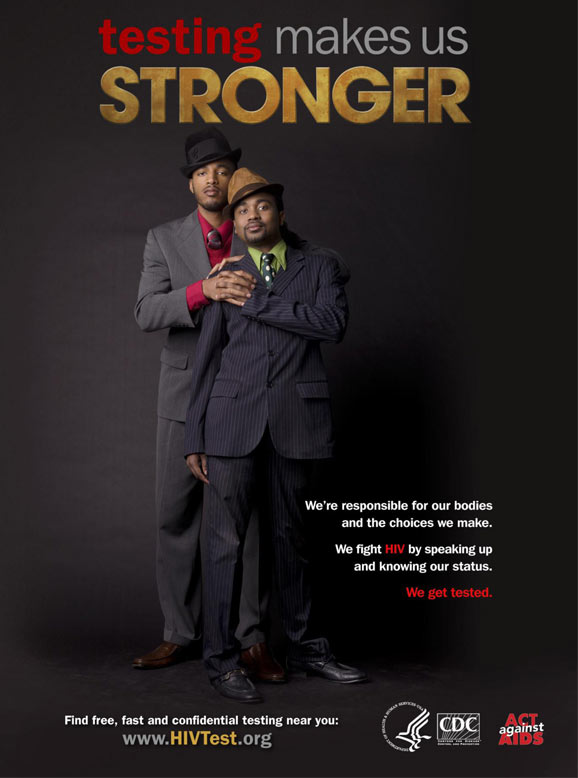
CDC rolls out ‘Strength Through Affirmation’

click on the image for a larger view

From Colorlines.com

When the Center for Disease Control and Prevention released its latest estimates of HIV infection earlier this month, it made unexpected headlines with a startling finding: 30 years into the epidemic, researchers have found a burgeoning epidemic among young black gay and bisexual men. This week, at the agency’s massive annual convening of HIV prevention scientists and experts, federal health officials rolled out a rare national campaign targeting black gay men.

According to the CDC, new infections among black gay and bisexual men under 30 years old shot up by 48 percent in recent years, rising from an estimated new 4,500 infections in 2006 to an estimated 6,500 in 2009. The findings—which also confirmed the U.S. continues to log 50,000 new cases a year overall, roughly half of which are among African Americans—prompted many to ask the perennial question: Why is this happening and what can be done about it?

The CDC has pointed to several factors, including limited access to both HIV testing and sexual health education, stigma surrounding HIV and homosexuality that has gone unchallenged in communities of color and a higher incidence rate of other sexual transmitted illnesses, which have been show to facilitate transmission of HIV.

Richard Wolitski, a deputy director in the CDC’s HIV/AIDS Prevention Division, spoke with Colorlines.com about the Testing Makes Us Stronger campaign and the CDC’s concern over the increase in HIV infection rates among black gay and bisexual men.

 Read the full article at Colorlines.com.

American Psychological Association supports same-sex marriage 157-0

From LifeSiteNews.com:

WASHINGTON, D.C., August 8, 2011  – The American Psychological Association (APA) has re-affirmed its support for same-sex “marriage” for the eighth consecutive year, this time with a more strongly-worded statement.

On the eve of this year’s annual convention, the association’s policymaking body supported same-sex “marriage” unanimously in a 157-0 vote.

The APA has backed “marriage” for homosexual couples since 2004, and marriage-like benefits since 1997, and now calls itself “a strong advocate for full equal rights for LGBT people for nearly 35 years.”

This year’s resolution is the first new wording of the association’s position since 2004, and includes stronger support for same-sex “marriage” by both asserting the possibility of long-term gay relationships as well as criticizing the stress that traditional marriage campaigns cause gays.

One APA official indicated that the recent spread of gay “marriage” in America, most notably in New York last month, has made the association’s public support for normalizing same-sex “marriage” more bold.

Read the full article.

One-third of workers have access to same-sex health benefits

From the New York Times:

WASHINGTON — In the first comprehensive count of domestic partner benefits by a federal government agency, the Bureau of Labor Statistics found that about one-third of all workers had access to health care benefits for same-sex partners.

 Bureau officials added two questions about domestic partner benefits for same-sex couples to the National Compensation Survey, a sample of 17,000 businesses and local governments, as a response to growing public interest in the topic, said Philip Doyle, assistant commissioner at the agency. The results were made public on Tuesday.

 Thirty-three percent of state and local government employees had access to domestic partner health benefits for same-sex couples, the survey found, slightly higher than the 29 percent of employees in private companies.

 Gary Gates, a demographer at the Williams Institute on Sexual Orientation Law at the University of California, Los Angeles, said the data collection “reflects contemporary reality of what constitutes a compensation package.” It will also allow researchers to track whether laws on same-sex marriage affect the availability of domestic partner benefits.

To read the full article, you can go to the New York Times online.


New resources to protect people living with HIV/AIDS

From blogAIDS.gov

To mark the one-year anniversary of the release of the National HIV/AIDS Strategy, the Justice Department has launched a new section of its Americans with Disabilities Act (ADA) website, http://www.ada.gov/aids.

Persons with HIV and persons with AIDS are covered by the Americans with Disabilities Act (ADA), which gives federal civil rights protections to persons with disabilities in public accommodations, employment, and state and local government services. The new web page provides important information and resources related to combating discrimination on the basis of HIV/AIDS.

Users can visit the site to file an HIV/AIDS discrimination complaint, to obtain ADA technical assistance materials related to HIV/AIDS, and to get the latest updates about the Department’s efforts to stop HIV/AIDS discrimination. The website also provides easy access to an extensive collection of ADA settlement agreements, as well as information about enforcement, mediation, technical assistance, and certification activities.

Go to blogAIDS.gov for the full article.

Get a copy of the National AIDS Strategy here.

“Silver Daddies” at risk for STDs, including HIV

From the Washington Blade:

The good news for older gay men is there are now many more ways to network, some may say, “hook up” with other guys, older and younger. In the past, one of the few places to meet someone was in a gay bar; today there are many more opportunities. Besides social clubs like Prime Timers, Metro Retirees or SAGE-DC, there is an explosion of social networking websites. One of the most popular for older guys is called “Silver Daddies” where all kinds of men from around the world can get to know each other.

And, of course one of the other factors enhancing the erotic life of older men is the introduction of “the little blue pill” — Viagra. The problem is not finding someone to have a sexual relationship with; the problem is keeping it safe.

With this new level of sexual freedom for gay male seniors comes the bad news in the reality of increases in HIV and other STD rates within this group.

Read the rest of the article on the Washington Blade Website.


LGBT to be included in collection of U.S. health data

From the Huffington Post:

For the first time, lesbian, gay, bisexual and transgender populations will be included in the National Health Interview Survey — one of the key sources used to gauge the health of Americans. The U.S. Department of Health and Human Services announced Wednesday morning that it will add questions on sexual orientation to the survey by 2013 and begin efforts to collect data on gender identity.

In a statement, HHS Secretary Kathleen Sebelius hailed the move as essential to helping policymakers and researchers identify health issues among LGBT populations, for which there is notoriously little data.

Read the full article on the Huffington Post.

News Release: Largest health group joins leading public health authorities in condemning marriage discrimination

From the Gay and Lesbian Medical Association:

NEWS RELEASE
June 27, 2011

New York, NY, June 27, 2011 – With the New York State now the sixth – and largest – state to end the exclusion of same-sex couples from marriage, the American Medical Association (AMA) adopted a policy position declaring that excluding same-sex couples from marriage is “discriminatory” and reaffirming existing AMA policy to support relationship recognition of gay and lesbian couples as a means of addressing health disparities faced by those couples and their families.

“With this deliberate policy statement by the American Medical Association, the nation’s doctors diagnose the pain and injury that exclusion from marriage inflicts on lesbian and gay couples, their children, and loved ones – and make clear that ending marriage discrimination is the cure,” said Evan Wolfson, founder and President of Freedom to Marry. “The AMA now joins every other mainstream public health organization in America in making the case for providing the freedom to marry – and the critical safety-net that comes with marriage – to loving, committed same-sex couples.”

The policy, H-65.973 Health Care Disparities in Same-Sex Partner Households, was adopted the AMA on Monday, June 20th, and states: Our American Medical Association: (1) recognizes that denying civil marriage based on sexual orientation is discriminatory and imposes harmful stigma on gay and lesbian individuals and couples and their families; (2) recognizes that exclusion from civil marriage contributes to health care disparities affecting same-sex households; (3) will work to reduce health care disparities among members of same-sex households including minor children; and (4) will support measures providing same-sex households with the same rights and privileges to health care, health insurance, and survivor benefits, as afforded opposite-sex households.

To read the full press release, go to the Gay and Lesbian Medical Association Website.


New Pitt Study Shows Gay and Bi Youth Experience Abuse More Often

Press release from UPMC and the University of Pittsburgh:

PITTSBURGH, June 22, 2011 – Young people who identify themselves as gay, lesbian or bisexual, experience same-sex attractions or engage in same-sex sexual ehaviors are more likely to experience sexual abuse, parental physical abuse and bullying from peers than other youth, according to a University of Pittsburgh Graduate School of Public Health study.

In addition, these adolescents – identified as “sexual minority youth” in the study – are more likely to miss school due to fear. The American Public Health Association recently published the findings online; the study will appear in the August issue of the American Journal of Public Health.

“The higher rates of abuse experienced by sexual minority youths are clearly one of the driving mechanisms underlying higher rates of mental health problems, substance use, risky sexual behavior and HIV by sexual minority adolescents and adults,” said Mark S. riedman, Ph.D., assistant professor of behavioral and community health sciences. “However, I cannot stress enough that these youth experience sexual and physical abuse and bullying because they identify as gay, lesbian or bisexual or experience same-sex attraction; abuse does not ‘cause’ sexual orientation or identification.”

Go to the UPMC Media Relations Website for the full press release.

Gay youth more at risk for health issues says recent CDC study

A recent national study of American high school students finds that those who identify as gay, lesbian or bisexual are more likely than their heterosexual counterparts to take unhealthy risks.

The study, conducted by the U.S. Centers for Disease Control and Prevention, used national survey data from 2001-2009. It found that rates of smoking, drinking or other drug use, risky sexual behaviors, suicidal behaviors and violence were higher among gay or bisexual teens than among their straight peers

“This report should be a wake-up call for families, schools and communities that we need to do a much better job of supporting these young people. Any effort to promote adolescent health and safety must take into account the additional stressors these youth experience because of their sexual orientation, such as stigma, discrimination and victimization,” Howell Wechsler, director of CDC’s Division of Adolescent and School Health (DASH), said in an agency news release. “We are very concerned that these students face such dramatic disparities for so many different health risks.”

The findings were published in the CDC’s journal, Morbidity and Mortality Weekly Report. You can read more about the report on the Advocate.com, Time.com, and  CNN.com.

People living with HIV disproportionately affected by hepatitis

From blog.AIDS.gov:

People living with HIV who are also living with viral hepatitis are at increased risk for serious, life threatening complications.  As a result, all persons living with HIV should be tested for Hepatitis B and Hepatitis C by their doctors. Co-infection with hepatitis may also complicate the management of HIV infection.

In order to prevent co-infection with Hepatitis B, the Advisory Committee on Immunization Practices recommends universal Hepatitis B vaccination of susceptible patients with HIV/AIDS.  Hepatitis A and Hepatitis B vaccines are also recommended for all men who have sex with men, users of illicit drugs, and others at increased risk of infection. There is no vaccine for Hepatitis C.

You can also read the full article on the Pitt Men’s Study Website.

HIV study: 96% reduction in HIV transmission

Press release from HIV Prevention Trials Network:

Thursday, 12 May 2011, 11 am EST
Washington, DC

Initiation of Antiretroviral Treatment Protects Uninfected Sexual Partners from HIV Infection (HPTN Study 052)

Men and women infected with HIV reduced the risk of transmitting the virus to their sexual partners through initiation of oral antiretroviral therapy (ART), according to findings from a large multinational clinical study conducted by the HIV Prevention Trials Network (HPTN), a global partnership dedicated to reducing the transmission of HIV through cutting-edge biomedical, behavioral, and structural interventions.

The study, known as HPTN 052, was designed to evaluate whether immediate versus delayed use of ART by HIV-infected individuals would reduce transmission of HIV to their HIV-uninfected partners and potentially benefit the HIV-infected individual as well. Findings from the study were reviewed by an independent Data and Safety Monitoring Board (DSMB).The DSMB recommended that the results be released as soon as possible and that the findings be shared with study participants and investigators. The DSMB concluded that initiation of ART by HIV-infected individuals substantially protected their HIV-uninfected sexual partners from acquiring HIV infection, with a 96 percent reduction in risk of HIV transmission. HPTN 052 is the first randomized clinical trial to show that treating an HIV-infected individual with ART can reduce the risk of sexual transmission of HIV to an uninfected partner.

“This is excellent news,” said Dr. Myron Cohen, HPTN 052 Principal Investigator and Associate Vice Chancellor for Global Health and Director of the Institute of Global Health and Infectious Diseases at the University of North Carolina at Chapel Hill. “The study was designed to evaluate the benefit to the sexual partner as well as the benefit to the HIV-infected person. This is the first randomized clinical trial to definitively indicate that an HIV-infected individual can reduce sexual transmission of HIV to an uninfected partner by beginning antiretroviral therapy sooner. HPTN recognizes the significant contribution that this study’s participants have made to furthering the progress in HIV treatment and prevention. We are very grateful for their participation.”

Media inquiries:

Matt Matassa
703.647.1909
mmatassa@fhi.org

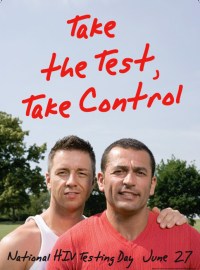
“Take the Test, Take Control” – National HIV testing day

National HIV Testing Day (NHTD) is an annual campaign coordinated by the National Association of People with AIDS to encourage people of all ages to “Take the Test, Take Control.”

Early HIV diagnosis is critical, so people who are infected can fully benefit from available life-saving treatments. Currently, almost 40 percent of people with HIV are not diagnosed until they already have developed AIDS. That can be up to 10 years after they first became infected with HIV. Finding out whether you are infected with HIV is the first step to improving your health and the health of your partners and your family.

Find out more about National HIV Testing Day and where to get tested.

Find out how you can help promote Testing Day.

President Obama speaks out for National HIV Testing Day.