
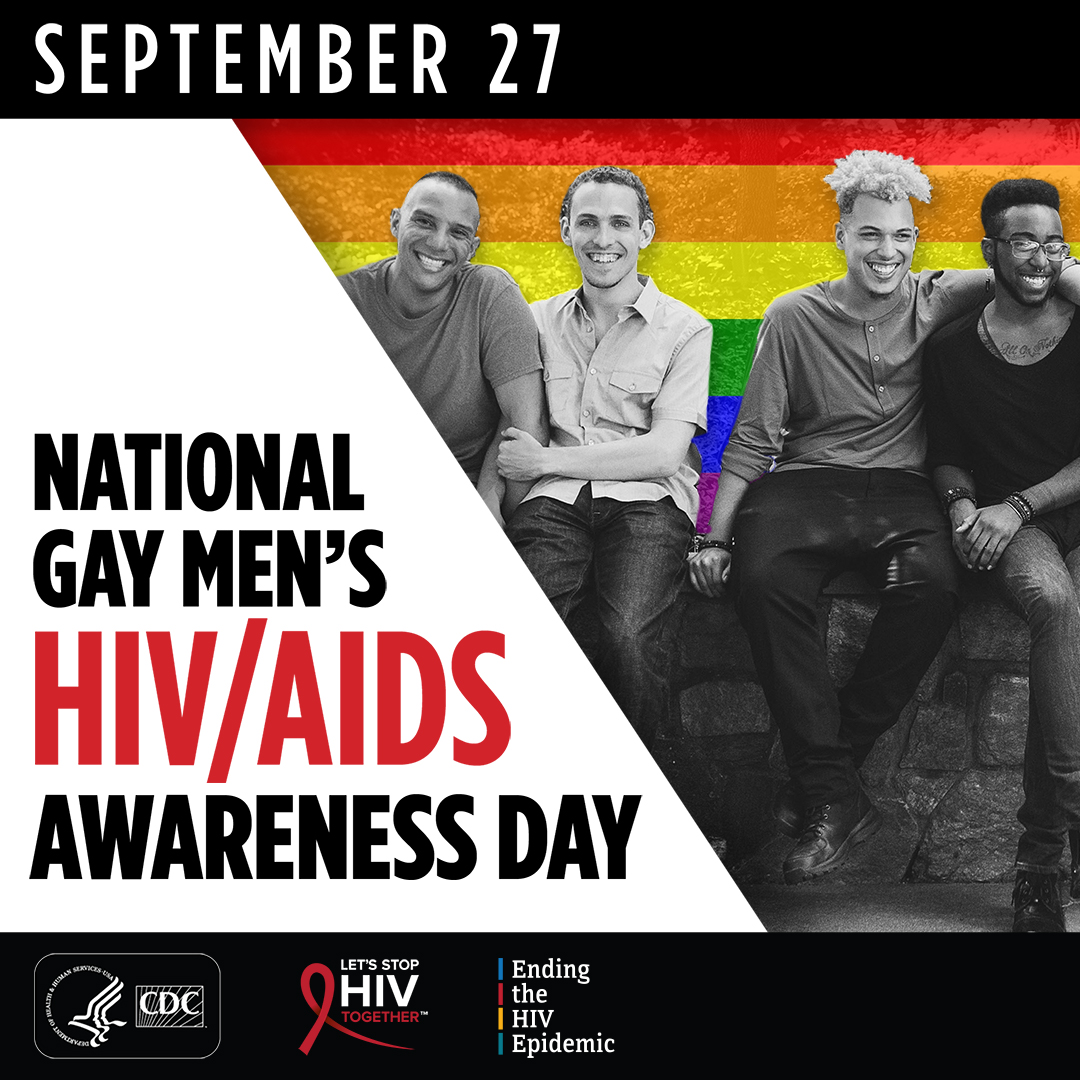
National Gay Men’s HIV/AIDS Awareness Day is Sept 27th

A letter from CDC’s Dr. Robyn Neblett Fanfair and Dr. Jonathan Mermin:

September 27 is National Gay Men’s HIV/AIDS Awareness Day (NGMHAAD), a day when we reaffirm our commitment to ending the disproportionate impact of HIV on gay and bisexual men in the United States.

Recently, encouraging progress shows declines in new infections among gay and bisexual men overall, as well as among many sub-groups most affected by HIV. However, gay and bisexual men continue to be most affected by HIV. Of the 31,800 estimated new HIV infections in the United States in 2022, 67% (21,400) were among this group. In 2022, almost half (47%) of new HIV infections among gay and bisexual men were in the South, and nearly 3/4 (73%) of those were among Black/African American and Hispanic/Latino men.https://www.hiv.gov/blog/cdc-observes-national-gay-mens-hiv-aids-awareness-day Let’s Stop HIV Together is a CDC campaign aimed at reducing HIV nationwied.
The annual number of estimated new HIV infections in 2022 compared to 2018 shows an overall decrease among gay and bisexual men of 10%. Age-specific trends reveal a 31% decrease among all young gay and bisexual men ages 13-24, and by region, a 16% decrease among gay and bisexual men who live in the South. Among Black/African American gay and bisexual men, there was a significant overall decrease of 16%, including a 26% reduction among young Black/African American men aged 13-24. Similarly, among white gay and bisexual men, there was a 20% overall decrease, including a 39% reduction among young white men aged 13-24. Cases among Hispanic/Latino gay and bisexual men remained stable, indicating a need for better understanding of the situation and improved support.

Read the full letter here and find resources for prevention and testing. You can also find HIV resources on on our testing page and our PrEP provider page. 

MISTR, Known for its Free Online PrEP and Long-Term HIV Care, is Now Prescribing DoxyPEP

From yahoo! finance

MISTR, the largest telemedicine provider offering free online PrEP and long-term HIV care in all 50 states, D.C., and Puerto Rico, is now prescribing Doxycycline Post-Exposure Prophylaxis (DoxyPEP), an antibiotic that reduces bacterial STIs, including gonorrhea, chlamydia, and syphilis. Beginning today, patients can now use MISTR’s seamless telehealth platform to receive DoxyPEP online for free.

With this launch, MISTR plans to further solve the issue of access and adherence to PrEP and HIV care, and now offers patients access to post-exposure care, in addition to their existing preventive and long-term HIV treatment options, which include PrEP and antiretroviral therapy (ART). This comes at a time when the rate of STIs continue to rise – in 2022, more than 2.5 million cases of syphilis, gonorrhea, and chlamydia were reported in the U.S.; of that population, gay and bisexual men are disproportionately affected.

“Despite an ongoing STI epidemic affecting the LGBTQ+ community, there are few resources available for this underserved, vulnerable community to get the preventative medication they need,” said Tristan Schukraft, CEO and Founder of MISTR. “I’m proud that MISTR is democratizing access to PrEP, HIV Care, and now DoxyPEP.”

Read the full article.

U.S. health officials to endorse common antibiotic as ‘morning-after pill’ to combat STIs

From PBS.org

U.S. health officials plan to endorse a common antibiotic as a morning-after pill that gay and bisexual men can use to try to avoid some increasingly common sexually transmitted diseases.

two men in bed holding hands

The proposed CDC guideline was released Monday, and officials will move to finalize it after a 45-day public comment period. With STD rates rising to record levels, “more tools are desperately needed,” said Dr. Jonathan Mermin of the Centers for Disease Control and Prevention.

The proposal comes after studies found some people who took the antibiotic doxycycline within three days of unprotected sex were far less likely to get chlamydia, syphilis or gonorrhea compared with people who did not take the pills after sex.

Read the full article on PBS.org.

Black Gay Men and Trans Women Are Well Protected by Injectable PrEP

From POZ.com

Long-acting injectable cabotegravir (Apretude) offered greater protection than daily pre-exposure prophylaxis (PrEP) pills for Black gay and bisexual cisgender men and transgender women, but Black people still had higher HIV incidence rates compared with their white peers regardless of which type of PrEP they used, researchers reported at the 30th Conference on Retroviruses and Opportunistic Infections (CROI).

Adherence was higher with the every-other-month injections than with daily pills in both groups, suggesting long-acting PrEP could help close the racial gap in HIV rates. “[Apretude] is a powerful HIV prevention tool to increase access to PrEP and address continued racial disparities in HIV incidence in the United States,” Hyman Scott, MD, MPH, of the San Francisco Department of Public Health, and colleagues concluded.

Although African Americans make up about 13% of the U.S. population, they account for more than 40% of all new HIV diagnoses, so effective and acceptable prevention interventions are urgently needed. While white gay and bi men have readily adopted oral PrEP using tenofovir disoproxil fumarate/emtricitabine (Truvada and TDF/FTC generic equivalents) or tenofovir alafenamide/emtricitabine (Descovy), uptake has been lower among Black men.

Read the full article on POZ.

Yes, Black men who have sex with men are at higher risk for getting HIV

m4m sometimes gets a fair amount of flak when we report that Black men who have sex with men have higher rates of new HIV infection as compared to other communities.

But the research is clear:
https://www.cdc.gov/nchhstp/newsroom/docs/factsheets/cdc-hiv-aa-508.pdf

The reason for it, in short, is due to issues like institutionalized racism in our health care system. So when we say Black men need to get tested for HIV, we’re not trying to stigmatize any particular group of people, we’re trying to get the word out so Black men can get tested and protect their health. Two Black men in an embrace

To address the problem, m4m (as part of the HIV Prevention and Care Project) is helping to provide free HIV self-test kits to anyone who resides in Pennsylvania. Kits are sent in the mail, in an unmarked package. Testing is easy and you get results in twenty minutes. Go to www.getmyHIVtest.com to order your kit. Knowing your status will protect you and your community, Black or white.

14 Things I Wish Queer Men Were Taught in Sex Ed By Zachary Zane

From Pride.com (By Zachary Zane)…

Oh, sex ed. A decade later, and the only thing I remember “learning” from it is “wear a condom.” I honestly don’t think I could tell you another single bit of information they “taught” me except for that men have a vas deferens, which is somewhere in the penis. (Testicles, maybe?)

Imagine how nice it would have been if they actually taught us something useful! Imagine if instead of scaring us and making us fear our own sexuality, sex ed courses taught us how to embrace and explore our sexuality safely! Can you imagine??

So here are 14 things I wish sex ed courses taught me! (And all queer men and queer folks, for that matter. Screw it—everyone can benefit from this!)

Sex and COVID-19

It may seem obvious that if a person is infected with COVID-19, they risk infecting others during sex. But people still have a lot of questions. Here’s an excerpt on the topic form the Mayo Clinic Website:

The virus spreads by respiratory droplets released when someone with the virus coughs, sneezes or talks. These droplets can be inhaled or land in the mouth or nose of a person nearby. Coming into contact with a person’s spit through kissing or other sexual activities could expose you to the virus. People who have COVID-19 could also spread respiratory droplets onto their skin and personal belongings. A sexual partner could get the virus by touching these surfaces and then touching his or her mouth, nose or eyes. In addition, the COVID-19 virus can spread through contact with feces. It’s possible that you could get the COVID-19 virus from sexual activities that expose you to fecal matter.

There is currently no evidence that the COVID-19 virus is transmitted through semen or vaginal fluids, but the virus has been detected in the semen of people who have or are recovering from the virus. Further research is needed to determine if the COVID-19 virus could be transmitted sexually.

Since some people who have COVID-19 show no symptoms, it’s important to keep distance between yourself and others if the COVID-19 virus is spreading in your community. This includes avoiding sexual contact with anybody who doesn’t live with you. If you or your partner isn’t feeling well or think you might have COVID-19, don’t kiss or have sex with each other until you’re both feeling better. Also, if you or your partner is at higher risk of serious illness with COVID-19 due to an existing chronic condition, you might want to avoid sex.

In case that wasn’t clear, The National Coalition of STD Directors (NCSD), in partnership with National Alliance of State and Territorial AIDS Directors (NASTAD), released a frequently asked questions resource regarding sex and COVID-19. In short, if you’re in the same room with someone who has the virus, you can get infected–sex or no sex.

If you have questions about getting tested, talk to your doctor or health care provider. You can also find testing in your area via a Google search. In Pennsylvania, call the Health Department at 1-877-PA-HEALTH (1-877-724-3258).

LGBT-friendly primary care improves STD screening rates

From medicalxpress.com

Bruce W. Furness, M.D., M.P.H., from the U.S. Centers for Disease Control and Prevention in Atlanta, and colleagues developed and evaluated a quality improvement initiative (Transforming Primary Care for LGBT People) to enhance the capacity of 10 federally qualified health centers (FQHCs; 123 clinical sites in nine states) to provide culturally affirming care.

The researchers found that FQHCs reported increases in culturally affirming practices, including collecting patient pronoun information (42.9 percent increase) and identifying LGBT patient liaisons (300.0 percent increase). Based on  and  (SOGI) from  among nine FQHCs, SOGI documentation increased from 13.5 to 50.8 percent of patients. Screening of LGBT patients increased from 22.3 to 34.6 percent for syphilis, from 25.3 to 44.1 percent for chlamydia and gonorrhea, and from 14.8 to 30.5 percent for HIV among the eight FQHCs reporting the number of LGBT patients.

“FQHCs participating in this initiative reported improved capacity to provide culturally affirming care and targeted screening for LGBT patients,” the authors write.

Read the full article.

STD rates likely skyrocketing in US as fewer people get tested during pandemic

From businessinsider.com

As clinics and health departments across the country have shuttered during the coronavirus pandemic, the nation’s roughly 2,200 disease detectives, the so-called “contact tracers” of infectious disease outbreaks, have been re-deployed to track where cases of COVID-19 — the disease caused by the novel coronavirus — are spreading, to try to stop those outbreaks in their tracks. It’s a necessary shift, but one that may have serious, long-term impacts for the country’s sexual health, and for President Trump’s year-and-a-half-old plan to “eliminate” HIV from the US by 2030.

[…] According to a recent NCSD survey of HIV and STD disease tracers around the country, 83% are forgoing their usual field visits as a result of this pandemic. Two-thirds of the country’s clinics (66%) have also reported decreases in health screenings and testing due to COVID-19.

Read the article.

Many dating apps continue to ghost health officials

From Politico.com

Many dating apps continue to ghost health officials and advocacy groups who seek their help fighting the epidemic of sexually transmitted diseases the platforms have helped bring about. Some of the sites, however, are starting to swipe right.

Even as rates of syphilis, gonorrhea, and chlamydia have climbed to record levels over the past few years, major dating apps and sites like Tinder have avoided taking action or even speaking up about the problem.