
Gay seniors and sexual minority stress
From LGBTQ Nation.com:
LOS ANGELES — Sexual minority stress, along with aging-related stress, jeopardizes the mental health of midlife and older gay men, according to a new study published by the American Journal of Public Health.
In the study, sexual minority stress included the men’s perceptions that they needed to conceal their sexual orientation, or that others were uncomfortable with or avoided them because of they are gay.
The study also found that legal marriage for same-sex couples may confer a unique protective effect against poor mental health. Having a same-sex domestic partner or same-sex spouse boosted the emotional health of the studied men, but having a same-sex legal spouse appeared to be the most beneficial relationship arrangement.
Read the full article on the LGBTQ Nation Website.
Health Alert – Shigella
Since mid-2011, the Pennsylvania Department of Health has received a number of reports of shigellosis due to Shigella flexeri, a species of Shigella that is infrequently diagnosed in Pennsylvania. The cases have occurred in the southeastern part of the state among men who have sex with men (MSM) who may or may not be HIV-positive.
What is Shigella?
Shigella is one of the bacterial agents that causes acute diarrhea. Symptoms often include cramping, fever and vomiting. The infection spreads easily from person to person by the fecal-oral route since a very small number of organisms are necessary to produce transmission.
How do you catch Shigella?
The Pennsylvania Health Alert Network reports “Shigella outbreaks have been previously reported in MSMs and are usually correlated with having multiple partners combined with unprotected high-risk sexual behavior. The fact that some of these patients are also HIV infected raises added concerns, not only due to the potential for transmission of HIV and other sexually transmitted infections through the same high risk behaviors, but also because immune-compromised individuals can have extended carriage of Shigella.”
What can you do?
Persons with diarrhea usually recover completely, although it may be several months before their bowel habits are entirely normal. Once someone has had shigellosis, they are not likely to get infected with that specific type again for at least several years. However, they can still get infected with other types of Shigella. Currently, there is no vaccine to prevent shigellosis. However, the spread of Shigella from an infected person to other persons can be stopped by frequent and careful hand-washing with soap.
For more information about Shigella, you can go to the Centers for Disease and Control and Prevention Website.
LGBT Cancer Network Expands Resources Directory Beyond NYC
The National LGBT Cancer Network, the first program in the country to address the needs of all lesbian, gay, bisexual and transgender (LGBT) people with cancer and those at risk, announced this past November that is has expanded its directory of LGBT-friendly cancer screening facilities beyond New York City.
The directory now covers facilities in California, Colorado, Connecticut, the District of Columbia, Florida, Georgia, Illinois, Maine, Maryland, Massachusetts, Minnesota, Oregon, Pennsylvania and Vermont.
You can search the directory for screenings in Pennsylvania on the Cancer Network Directory.
New H.I.V. cases and AIDS deaths going down in British Columbia
From the New York Times:
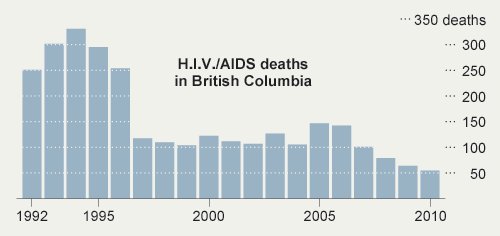
New H.I.V. cases and AIDS deaths are both going steadily down in British Columbia, according to data released last week.
“We’re particularly pleased to see that our treatment-as-prevention strategy has taken off big-time,” said Dr. Julio S. G. Montaner, director of the British Columbia Center for Excellence in H.I.V./AIDS. His center was a pioneer in the strategy, which involves searching aggressively for people at risk of H.I.V. infection, talking them into being tested and putting those who are infected on antiretroviral drugs immediately, which lowers by 96 percent the chances that they will infect others.
To read the full article, go to the New York Times Website.
“Many Americans with HIV do not have their condition under control”
Recent Centers for Disease Control and Prevention data show that many Americans with HIV do not have their condition under control. American Medical News reports:
Of the nation’s nearly 1.2 million people with the illness, only 28% have a suppressed viral load, according to a CDC study published in the Dec. 2 Morbidity and Mortality Weekly Report. A suppressed viral load improves patients’ health and dramatically decreases their risk of transmitting the virus through sexual activity.
Part of the problem is that the antiretroviral treatment has been so effective that some patients do not see the need to regularly take their medication, said Dr. Sharp, director of the Center for Comprehensive Care in New York City. The center is an HIV/AIDS clinic at St. Luke’s/ Roosevelt Hospital.
“It’s hard for people to believe” what can happen if the virus is left untreated, she said.
At the same time, one in five Americans infected with HIV does not know he or she has the condition, the CDC said. Only about half of people diagnosed with HIV receive ongoing medical care and treatment.
To help remedy the problem, the CDC urges doctors to increase testing for HIV during routine medical visits. The agency recommends that doctors test everyone between ages 13 and 64. People at high risk of contracting the virus, including injection drug users and men who have sex with other men, should be tested at least once a year, the CDC says.
Read the full article on amednews.com.
Some healthcare providers still deny treatment to HIV+ patients
From 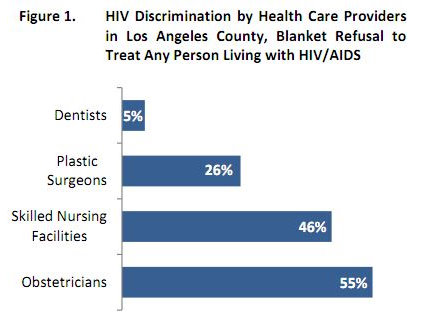 Thinkprogress.com:
Medical progress now ensures that HIV/AIDS is no longer a death sentence, but only for those who can access good medical care. The Centers for Disease Control and Prevention reports that almost three out of four Americans with HIV are not receiving enough medicine or regular health care “to stay healthy or prevent themselves from transmitting the virus to others.” Out of the 1.2 million people in the U.S. have HIV, 850,000 aren’t receiving regular treatment to keep the virus at a low enough level to prevent transmission or hurt their own health and 240,000 Americansdon’t even know they’re infected with HIV.
For some, medical treatment is hard to come by. A Williams Institute study found that 5 percent of dentists in Los Angeles refused services to those with HIV/AIDs, a rate that is “lower than that of other health care providers. Over the past decade, “55% of obstetricians, 46% of skilled nursing facilities, and 25% of plastic surgeons” in L.A. “had policies that specifically discriminated against people living with HIV or AIDS.” Successful treatment rates “were lowest in blacks and women,” according to CDC director Dr. Thomas Frieden.
Read the full article on Thinkprogress.com.
Hep C deaths now surpass AIDS
From POZ.com…
Chronic hepatitis C virus (HCV) infection is associated with more deaths than HIV infection, according to sobering new data presented by the U.S. Centers for Disease Control and Prevention (CDC) on Tuesday, November 8, at the 62nd annual meeting of the American Association for the Studies of Liver Diseases (AASLD) in San Francisco.
The discouraging findings, presented by Scott Holmberg, MD, MPH, chief of the CDC’s Division of Viral Hepatitis Epidemiology and Surveillance Branch, come from data involving 21.8 million deaths reported to the National Center for Health Statistics
between 1999 and 2007. The only cases included in the analysis involved reports that specified HIV, AIDS, HCV or hepatitis B virus (HBV) infection as possible contributors to the deaths.
Most viral hepatitis deaths occurred in people in the prime of their lives. About 59 percent of people who died of complications related to hepatitis B were between the ages of 45 and 64. The impact of chronic hepatitis C was even more substantial—roughly 73 percent of the deaths related to HCV were in baby boomers.
Not surprisingly, death rates were highest among certain populations. For example, people coinfected with both HBV and HCV faced a 30-fold increase in the risk of death from liver disease or related complications. Alcohol abuse was associated with a four-fold increase in the risk of death. Coinfection with HIV nearly doubled the risk of death from HBV-related complications and quadrupled the risk of death from HCV-associated liver disease.
To read the full article, go to POZ.com.
Joint Commission releases LGBT field guide
 A new field guide from the Joint Commission urges US hospitals to create a more welcoming, safe, and inclusive environment that contributes to improved health care quality for lesbian, gay, bisexual, and transgender (LGBT) patients and their families.
The field guide features a compilation of strategies, practice examples, resources, and testimonials designed to help hospitals in their efforts to improve communication and provide more patient-centered care to their LGBT patients. The guide, Advancing Effective Communication, Cultural Competence, and Patient- and Family Centered Care for the Lesbian, Gay, Bisexual, and Transgender (LGBT) Community, was developed with support from the California Endowment and is available for free download below.
An independent, not-for-profit organization, The Joint Commission accredits and certifies more than 19,000 health care organizations and programs in the United States. Joint Commission accreditation and certification is recognized nationwide as a symbol of quality that reflects an organization’s commitment to meeting certain performance standards.
You can get the Field Guide on the Joint Commission website.
Be Well Pittsburgh! – helping uninsured Pittsburghers find health care
Be Well Pittsburgh! collaborates with health care consumers, health care providers, social service providers and community organizations to improve uninsured Pittsburghers’ awareness of and access to health care resources. Be Well! was founded in 2005 and was originally funded by a Seed Award from the Sprout Fund. The Seed Award supported the printing of 6,000 copies of a resource booklet entitled “Be Well! Healthcare Options for the Uninsured.” The booklet was distributed in public venues
and through social service organizations in Pittsburgh. Its release was launched at a community health fair at the Quiet
Storm coffeehouse during the summer of 2006. The information was listed online at http://www.bewellpgh.org shortly thereafter.
The information in the booklet and on the website was compiled using some existing resources and through additional research, as well as through information from health care providers themselves. All resources must be free or offered at reduced cost for
uninsured persons.
Be Well! continues to revise, update, print and distribute the booklets as funds allow. They also continually revise and update the
website. They act as a reference source to individuals and service providers, participate in community events, and hold community information sessions on health care resources for uninsured people.
You can check out Be Well Pittsburgh! for services and more information.
“Stigma May Take Toll on Lesbians, Gays”
A post from MedlinePlus.com:
The stigma and inequalities that lesbian, gay and bisexual people face on a daily basis can increase their stress level and affect their well-being, according to a new study.
“Imagine living life anticipating exclusion from your friends, family and professional circles simply because of who you are and who you love — that resulting stress takes a toll on one’s life and health,” said the study’s co-author, Ilan Meyer, of the University of California, Los Angeles School of Law.
The researchers set out to determine how stress resulting from daily, non-traumatic events, such as isolation at work and estrangement from families, affected 57 lesbian, gay or bisexual (LGB) people. The researchers were interested in everyday occurrences, rather than overt abuse or hate crimes.
Black and Hispanic study participants reported the stress from homophobia, racism and sexism led to certain missed life opportunities, including educational advancement, and less self-confidence.
“For members of minority groups, day-to-day life experiences that may seem minor to others can and do have significant and lasting impact on one’s well-being,” said Meyer. “The idea that simply walking out your door will expose you to societal rejection and stigma creates a climate of stress that can lead to detrimental, long-term consequences.”
To read the full article, go to MedlinePlus.com.
The study was recently published online in Sexuality Research and Social Policy.
“Reversing the Alarming HIV Increase Among Black Gay Men, Part 2”
From Blackvoicesnews.com….
The second of a two-part series examining the high rates of new HIV infection among Black gay and bisexual men. Part 1 described the new data detailing the dramatic increases in new infections, examined some of the reasons driving the numbers and described the CDC’s new social-marketing initiative, designed to encourage testing among Black MSM.
In light of the persistent increase in new infections among MSM (men who have sex with men)–and despite the Centers for Disease Control and Prevention’s new testing initiative–a consensus has emerged among prominent Black gay men who have leadership positions in HIV/AIDS policy, prevention and public health: A larger investment is needed from public and private sources, as well as a more “holistic” approach to Black gay men’s sexual health.
Read the full article on Blackvoicesnews.com.
$813 million in federal money will go to HIV state drug programs
From michiganmessenger.com …
The federal government Monday announced more than $1.89 billion in funding to states to fight the HIV epidemic with access to care and with more cash for the failing AIDS Drug Assistance Program.
According to an HHS press release, $813 million of that money will go directly to the ADAP programming. An additional $8,386,340 will be issued as a supplement to 36 states and territories currently facing a litany of unmet needs and access issues. The additional money is designed to help those programs reduce or eliminate their waiting lists. They also released an additional $40 million to assist states and territories currently refusing coverage for people in need to reduce the number of people waiting.
To read the full article, go to michiganmessenger.com.
National Gay Men’s HIV/AIDS Awareness Day is September 27, 2011
 National Gay Men’s HIV/AIDS Awareness Day is observed each year on September 27 to focus on the continuing serious and disproportionate effects of the human immunodeficiency virus infection (HIV) on gay, bisexual, and other men who have sex with men (MSM) in the United States. In 2008, an estimated 580,000 MSM were living with HIV infection.
Based on these findings, sexually active MSM might benefit from more frequent HIV testing (e.g., every 3 to 6 months). CDC is using the 2011 National Gay Men’s HIV/AIDS Awareness Day as an opportunity to highlight this information for gay men and their health-care providers. Additional information is available at http:/www.cdc.gov/msmhealth.
Search for free testing near you by clicking on the “find testing” tab above. You can also email us at PMS@stophiv.pitt.edu for more information.
What can be done about high rates of HIV infection among Black gay and bi men
The first of a two-part series by writer and commentator Rod McCullom examining what can be done to reverse the high rates of new HIV infection among Black gay and bisexual men…
__________
The number of new HIV cases in the United States has remained fairly stable at about 50,000 per year between 2006 and 2009, according to data from the Centers for Disease Control and Prevention (CDC) that was published in early August in the online scientific journal PLoS ONE.
Predictably, the epidemic continues to affect Black America disproportionately: Forty-four percent of all new infections occurred among African Americans, who make up only about 13 percent of the population. And gay and bisexual men, who make up only an estimated two percent of the population, accounted for 61 percent of all new HIV infections in 2009. Young Black gay and bi men–“men who have sex with men” (MSM), in public health jargon–ages 13 to 29 experienced the greatest increases, with infection rates skyrocketing by more than 48 percent.
But government researchers described the soaring seroconversions among young Black MSM as “alarming.” “The data is not surprising because we’ve been talking about young Black gay and bisexual men for some time,” says A. Cornelius Baker, a member of the Presidential Advisory Council HIV/AIDS (PACHA), the senior communications consultant at AED Center on AIDS & Community Health and board chair of the Black AIDS Institute. “Now we have an opportunity to make some progress with bold and comprehensive strategies.”
Contunue reaeding the article at Balckvoicenews.com.
__________
 Rod McCullom blogs on politics, pop culture and Black gay news at rod20.com. His commentary appears in Ebondy, The Advocate, ColorLines and other popular media.
Medical Schools don’t teach about gay health
From 365gay.com…
Future doctors aren’t learning much about the unique health needs of gays and lesbians, a survey of medical school deans suggests.On average, the schools devoted five hours in the entire curriculum to teaching content related to lesbian, gay, bisexual and transgender patients, according to the survey results appearing in Wednesday’s Journal of the American Medical Association. A third of the schools had none during the years students work with patients.
More than a quarter of the medical school deans said their school’s coverage of 16 related topics was “poor” or “very poor.” The topics included sex change surgery, mental health issues and HIV-AIDS. While nearly all medical schools taught students to ask patients if they “have sex with men, women or both” while obtaining a sexual history, the overall curriculum lacked deeper instruction to help “students carry that conversation as far as it needs to go,” said lead author Dr. Juno Obedin-Maliver of the University of California, San Francisco.
Got to 365gay.com for the full story.
Dan Savage at Whitman College – Is bi-sexuality real in men?
Syphilis up among minority gay, bisexual men
From Reuters.com…
Syphilis is a sexually transmitted bacterial infection that can be easily cured with antibiotics in the early stages. But many people do not have symptoms early on, or don’t recognize the symptoms, and continue to transmit the infection. In the U.S., syphilis has been on the rise since 2000, when the national rate hit an all-time low of 2.1 cases per 100,000 people.
That increase has been largely among men, who had a rate of just under 8 cases per 100,000 in 2009 (versus 1.4 cases per 100,000 women), according to the CDC. And studies have suggested that gay and bisexual men now account for a majority of new syphilis cases.
Health officials are concerned about the resurgence not only because of syphilis itself, but also because the infection makes people more vulnerable to contracting HIV, the virus that causes AIDS.
Now the new findings, reported in the Annals of Internal Medicine, show that minorities — and young men, in particular — are being hit hardest by syphilis.
To read the full story, go to Reuters.com.
CDC rolls out ‘Strength Through Affirmation’
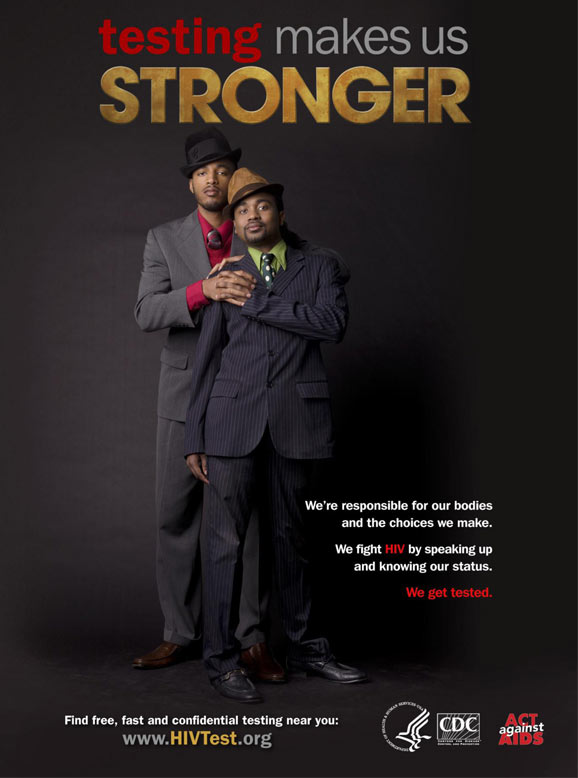
click on the image for a larger view
From Colorlines.com…
When the Center for Disease Control and Prevention released its latest estimates of HIV infection earlier this month, it made unexpected headlines with a startling finding: 30 years into the epidemic, researchers have found a burgeoning epidemic among young black gay and bisexual men. This week, at the agency’s massive annual convening of HIV prevention scientists and experts, federal health officials rolled out a rare national campaign targeting black gay men.
According to the CDC, new infections among black gay and bisexual men under 30 years old shot up by 48 percent in recent years, rising from an estimated new 4,500 infections in 2006 to an estimated 6,500 in 2009. The findings—which also confirmed the U.S. continues to log 50,000 new cases a year overall, roughly half of which are among African Americans—prompted many to ask the perennial question: Why is this happening and what can be done about it?
The CDC has pointed to several factors, including limited access to both HIV testing and sexual health education, stigma surrounding HIV and homosexuality that has gone unchallenged in communities of color and a higher incidence rate of other sexual transmitted illnesses, which have been show to facilitate transmission of HIV.
Richard Wolitski, a deputy director in the CDC’s HIV/AIDS Prevention Division, spoke with Colorlines.com about the Testing Makes Us Stronger campaign and the CDC’s concern over the increase in HIV infection rates among black gay and bisexual men.
Read the full article at Colorlines.com.
American Psychological Association supports same-sex marriage 157-0
From LifeSiteNews.com:
WASHINGTON, D.C., August 8, 2011 – The American Psychological Association (APA) has re-affirmed its support for same-sex “marriage” for the eighth consecutive year, this time with a more strongly-worded statement.
On the eve of this year’s annual convention, the association’s policymaking body supported same-sex “marriage” unanimously in a 157-0 vote.
The APA has backed “marriage” for homosexual couples since 2004, and marriage-like benefits since 1997, and now calls itself “a strong advocate for full equal rights for LGBT people for nearly 35 years.”
This year’s resolution is the first new wording of the association’s position since 2004, and includes stronger support for same-sex “marriage” by both asserting the possibility of long-term gay relationships as well as criticizing the stress that traditional marriage campaigns cause gays.
One APA official indicated that the recent spread of gay “marriage” in America, most notably in New York last month, has made the association’s public support for normalizing same-sex “marriage” more bold.
 m4mHealthInfo.org